
Auditing the final accounts of a completed project is a crucial step in ensuring the legality and transparency of the construction investment process. This activity independently verifies costs and ensures compliance with regulations on investment cost management. Decree 99/2021/ND-CPPreparing and approving investment capital settlement reports is mandatory for projects using state capital and important projects. Choosing a reputable independent auditing firm helps increase the reliability and legal value of the settlement report, while reducing legal risks for the investor.
In the context of increasingly stringent accounting, auditing, and tax laws, especially regarding deductible expenses for corporate income tax purposes, final project audits play a crucial role. The audit report provides objective evidence that helps investors explain their financial situation to tax authorities, avoiding the risk of expense exclusions or tax arrears. Completing the audit early facilitates project handover, fixed asset recognition, optimized depreciation, and ensures stable business operations.
Definition and nature of final project audit
Auditing the final accounts of completed projects is a crucial control step in the construction investment cycle, helping to independently verify costs and ensure that the final accounts report complies with the law. This activity assesses the accuracy and reasonableness of all investment costs, thereby protecting the financial interests of the investor and increasing transparency. In the context of increasingly stringent regulations on cost management, final accounts audits have become an important basis for approving investment capital and completing project procedures.
Define audit of final project accounts according to accounting and auditing standards
Project completion audit is the process of examining, verifying, and providing an independent opinion on the accuracy and reasonableness of the investment capital settlement report prepared by the investor. Performed by a qualified independent auditing firm, this activity assesses all investment costs from the preparation phase to the completion of construction, comparing them with approved norms, unit prices, estimates, and contract terms, in order to ensure the transparency, legality, and accuracy of the settlement report.

The ultimate goal of a project completion audit is to provide reasonable assurance that the final settlement report does not contain material misstatements due to fraud or error. This work includes examining the completeness and accuracy of legal documents, payment vouchers, work performed, and construction quality. All expenses deemed legitimate must be supported by sufficient legal and factual basis.
Absolute role audit of final project accounts in investment capital management
The audit of completed project accounts acts as a final "filter," ensuring that investment capital, especially state capital or loans from credit institutions, has been used for its intended purpose, economically and efficiently. This helps to publicize and ensure transparency in the use of funds, building trust among stakeholders.
| Role | Detailed description | Legal basis |
| Determining asset value | Accurately determining the actual value of fixed assets is crucial for their recognition, management, and subsequent depreciation calculations. | Vietnamese Accounting Standards (VAS) |
| Basis for approving final accounts | The audit report is the most important and mandatory basis for the competent authority (investor, financial authority) to make a decision on officially approving the final investment capital value. | Decree 99/2021/ND-CP |
| Support for disbursement | This serves as the basis for the bank or financial institution to disburse the remaining capital (if any) and close the investment tracking book. | Credit Agreement/Capital Management Regulations |
| Minimize tax risks. | Demonstrate the validity of investment expenses to the tax authorities, ensuring that the expenses are included in the asset's cost basis and are depreciated/deductible when calculating corporate income tax. | Corporate Income Tax Law |
The core purpose and benefits of final project audit.
The purpose of conducting a final project audit is not merely to comply with the law, but also to bring significant added value to the investor and stakeholders, ensuring economic efficiency in capital management. This process helps to comprehensively assess the use of capital and optimize investment performance.
Audit of final accounts for completed projectsFor the investor (developer)
Conducting a final project audit provides legal and financial peace of mind for the investor. The audit report is a solid legal protection tool.
Verify the validity of investment costs.
The project owner needs to determine whether all expenses incurred qualify for recognition as part of the asset's value. The auditor will examine the legality of documents, contracts, and acceptance reports for the quantity and quality of the work.

They will assess whether these costs are within the approved budget and comply with state-mandated standards and unit prices. The final project audit process helps to promptly eliminate unreasonable costs, avoiding complex explanations later on.
Complete the settlement and disbursement procedures.
An audit report is an indispensable document to submit to the investment capital settlement approval authority. If the project involves borrowing, this report is also a condition for the bank or financing organization to disburse the remaining committed capital and close the project file. This is crucial for the investor to cease their responsibility for managing construction investment capital.
Audit of final accounts for completed projectsfor government agencies and funding agencies
Auditing the final accounts of completed projects ensures transparency and accountability. This activity plays a crucial role in protecting the interests of government agencies, financing banks, and shareholders.
Basis for approving investment capital settlement
The agency responsible for reviewing and approving final accounts (the finance department or the relevant ministry) uses the audit results as an important basis for making decisions on approving the final value. An independent audit report helps minimize risks and liability for this agency.
Control the use of budget funds (if any).
For projects using state budget funds, auditing the final accounts of completed projects is an effective tool for controlling compliance with regulations on bidding, economic and technical standards, and investment cost management. This demonstrates the state's seriousness in combating losses and waste in public investment.
Legal basis and scope of application of audit of final project accounts
The procedures for auditing the final accounts of completed projects are clearly stipulated in the legal framework governing investment in construction and independent auditing. Understanding these legal bases is crucial to ensuring compliance and the legal validity of the final accounts report..
Key legal documents
Businesses, especially investors and auditors, need to be familiar with the following documents: This helps define the scope of work and ensures that all procedures are based on solid legal grounds.
- Government Decree 99/2021/ND-CP dated November 11, 2021, regulates the management, payment, and settlement of projects using public investment capital.
- Circular 96/2021/TT-BTC of the Ministry of Finance provides guidance on several aspects of preparing, presenting, approving, and publishing final accounts reports for completed capital construction projects.
- The Law on Independent Auditing and Vietnamese Auditing Standards (VSA).
According to Circular 96/2021/TT-BTC, investment capital settlement reports must be independently audited in the following cases:
| Project target | Request for independent audit | Note |
| A nationally important project. | Obligatory | |
| Group A and Group B projects (using public investment funds). | Obligatory | Except for projects authorized by the competent authority to make investment decisions, auditing is not required. |
| The project utilizes other sources of funding as stipulated by the investment decision-maker or as required by the donor (bank, credit institution). | Obligatory | This is commonly applied to BOT projects, PPP projects, or projects with large loan amounts. |
Concept and classification of eligible investment costs
When conducting a final project audit, auditors focus on verifying various types of investment costs. Proper and legitimate classification of costs forms the basis for determining the original cost of fixed assets later on.
Classification of expenses according to Circular 96/2021/TT-BTC
According to regulations, the total investment costs subject to audit include the following main categories: These cost categories must be compared in detail with the approved budget and original supporting documents.
- Construction costs include the cost of materials, labor, construction machinery, and overheads.
- Equipment costs: These include the cost of purchasing, installing, and training for operation.
- Project management costs: The costs incurred by the investor for managing the project from the preparation phase to completion.
- Construction investment consulting costs: Costs for surveying, project planning, design, supervision, and verification.
- Other costs include relocation costs, insurance, interest on loans (during construction), and contingency costs.
Key elements in the final project audit process
Auditors will focus on the highest-risk areas of the project to ensure the validity of the data. Identifying key points helps optimize audit resources and improve the quality of the report.
Auditing legal documents and investment capital sources.
This is a crucial step in the final project audit process. Auditors must verify the completeness and validity of the legal documents that served as the basis for the project's implementation.
- Decisions on investment policies and investment decisions by competent authorities.
- Detailed planning, building permit.
- Results of budget appraisal, bidding results, and signed economic contracts.
- Verify whether investment capital (equity capital, borrowed capital, budget capital) is being mobilized and used correctly according to the approved structure.
Audit of investment costs
This is the most complex and significant part of the final project audit process. The accuracy of the actual investment costs is a decisive factor in ensuring the integrity of the entire final settlement report.
Auditing actual quantities and unit prices.
Auditors will compare the actual volume of work completed and accepted (according to the completion acceptance report) with the volume in the design and cost estimate documents. Any discrepancies in volume (if any) must be explained by valid adjustment or additional costs. Regarding unit prices, auditors will check the application of unit prices as per the contract, comparing them with market prices or state-mandated norms at the time of signing the contract.
Auditing project management costs and consulting fees.
These two types of costs are usually calculated as a percentage (%) of the construction and equipment costs. The final project audit must ensure that this percentage does not exceed the maximum level stipulated in current legal documents of the Ministry of Construction (e.g., circulars on project management cost norms). Any actual costs exceeding the norm must be supported by valid documentation and approved by the investment decision-maker.
Auditing interest expenses and provisions
Interest expense capitalized into the project value must be interest incurred during the construction period and supported by bank documents. The auditor will examine the timing of the suspension of interest capitalization (when the asset is ready for use) according to VAS. Contingency costs must be handled in accordance with regulations; any remaining amount (if not used) must be excluded from the final investment value.
Auditing the value of assets and liabilities
After verifying the costs, the next step in a project completion audit is to accurately determine the value of assets and the status of liabilities. This step ensures that the values recorded in the accounting books are reasonable and that all financial obligations are fully reflected.
Determining the recorded value of assets
Auditors determine the final settlement value of each project item, ensuring that this total value is the original cost of the fixed assets to be recorded in the accounting books. This helps the investor avoid errors in asset accounting.
Check accounts receivable and accounts payable.
Review all liabilities incurred during the project implementation. Verify that advances, performance guarantees, and retention funds for construction warranties are being tracked and processed in accordance with regulations. This ensures that the final settlement report is comprehensive and fully reflects the financial responsibilities of the investor.
The independent audit process of audit of final project accounts
The audit process for completed projects is conducted according to Vietnamese Auditing Standards (VSA) to ensure quality. Adherence to these standards helps guarantee the independence, objectivity, and reliability of the audit results.
Planning and preparation phase
Auditors must gather information about the project, the investor, and the main contractor. They must identify significant risks, particularly risks related to unforeseen costs or large adjustments and additional expenses. Based on this risk assessment, auditors will design the audit methodology, determine the scope of cost sampling, and allocate resources. Detailed planning helps optimize the time and cost of auditing the final accounts of the completed project.
Audit execution phase
Auditors perform basic audit procedures, including: These procedures aim to gather sufficient and appropriate audit evidence to form an opinion.
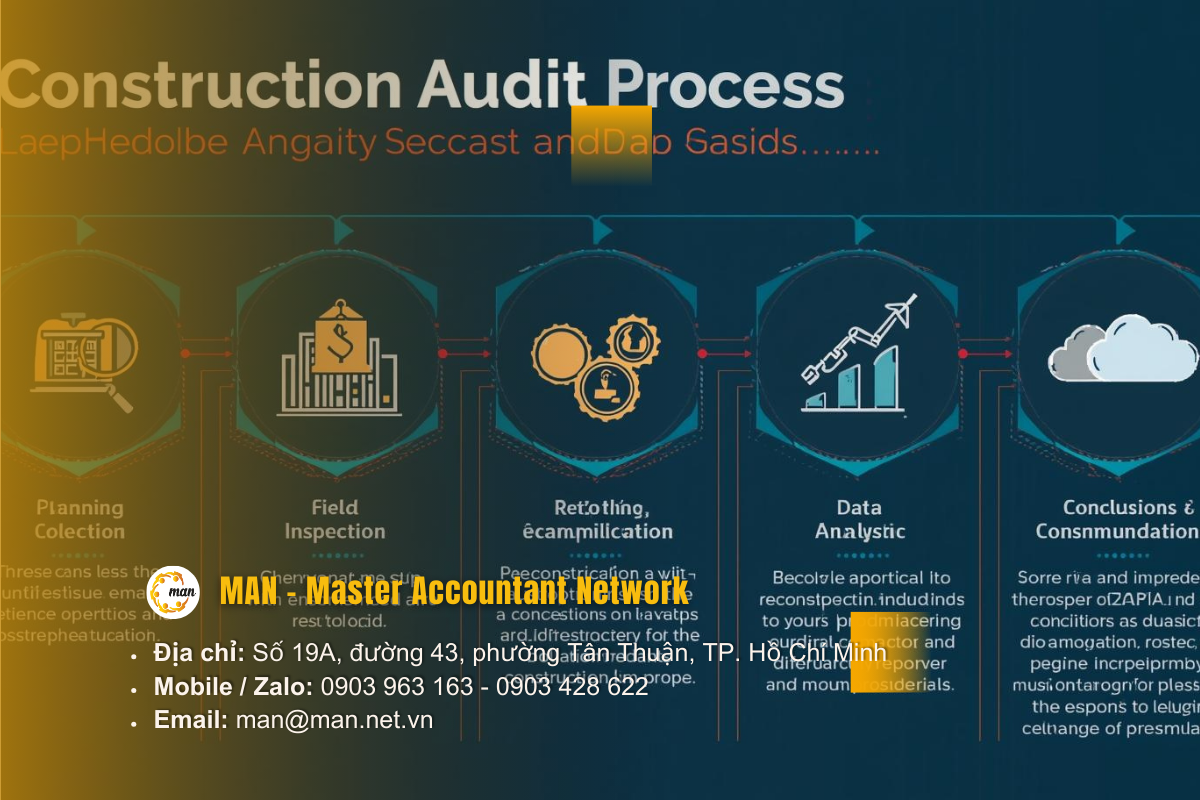
- Compliance test: Checking compliance with bidding procedures, quality management procedures, and quantity management procedures according to state regulations and the contract.
- Analytical procedures: Comparing actual costs with estimated costs, budgeted costs, or costs of similar projects.
- Test of details: Randomly or risk-based sampling of large payment documents and important acceptance reports to verify their accuracy, reasonableness, and validity.
- Conducting on-site inspections: Auditors may conduct on-site inspections (if necessary and permitted) to directly verify the completed work volume and condition.
Completion and reporting phase
After completing the fieldwork and analysis, the auditor compiles the results and prepares a draft audit report. The audit report will include:
- Audit opinion: unqualified, qualified, or disclaimer.
- Summarize any errors, invalid expenses, or items requiring adjustment.
- Recommendations to the investor regarding the completion of the documentation.
The investor uses this report to finalize the investment capital settlement report and submit it to the auditing agency for approval. The auditing unit responsible for the final settlement of the completed project is responsible for coordinating with the investor to provide explanations when necessary.
Selecting the auditing firm and evaluation criteria for audit of final project accounts
Choosing the right auditing firm for a completed project's final accounts is crucial, directly impacting the legal validity and subsequent approval process. A reputable auditing partner will give the investor greater confidence when working with the reviewing authorities.
Criteria for evaluating audit firms
A highly rated audit firm needs to meet the following criteria: These are key criteria that ensure the quality of service and the acceptability of the audit report.

- Expertise: Our team of auditors are certified professionals (CPA Vietnam) and possess in-depth expertise in the field of basic construction, with a thorough understanding of norms, unit prices, and project management procedures.
- Experience: Possesses extensive experience in auditing the final accounts of completed Group A and Group B projects, or projects of equivalent scale and complexity.
- Reputation: The auditing firm is fully licensed by the Ministry of Finance and widely accepted by the relevant auditing agencies (Department of Finance, Tax Department).
- Reliable: Ensuring complete independence, objectivity, and confidentiality of information throughout the entire process.
Comparison of independent audit and financial statement review
Many people confuse independent audits of completed project settlements with the verification and approval of settlements carried out by state agencies. Although related, these two activities are different in nature, purpose, and implementing units.
| Characteristic | Independent audit | Auditing the final accounts |
| Implementing unit | Independent auditing firm (licensed by the Ministry of Finance) | Competent state agencies (Department of Finance, Finance and Planning Office, Project Management Board). |
| Nature of the job | Verify and provide an independent opinion on the accuracy and reasonableness of the data. | Assess and approve the final investment capital settlement value, and make the final decision. |
| Mandatory | Mandatory for projects as stipulated in Decree 99/2021/ND-CP and Circular 96/2021/TT-BTC. | Mandatory for all projects using state funds. |
| Legal value | It serves as an important basis for the agency to review the final accounts (indirect impact). | This is the final legal decision regarding the value of the investment capital (direct impact). |
Conducting independent audits of completed project accounts provides the reviewing agency with more reliable evidence, reducing the time and workload of the review process. The audit report serves as an important reference point to expedite the final approval decision-making process.
Conclude
Auditing the final accounts of completed projects is an essential process, ensuring transparency, legality, and efficiency for all construction investment projects. This activity not only helps ensure compliance with the law but also protects the investor's finances from tax authorities and auditors, supporting a smooth transition from investment to operation and business. Accurately identifying legitimate costs, eliminating unreasonable expenses, and ensuring data consistency are the most important objectives of project final account auditing.
Ensuring compliance with the law and optimizing tax obligations with auditing services and full-service tax accounting From MAN – Master Accountant Network. With a team of experienced professionals, MAN provides comprehensive solutions: tax audits, construction project audits, financial reporting, and cost management consulting. We help businesses review and optimize costs, prevent legal risks, and confidently face any inspection. Contact MAN today for expert advice and experience professional, accurate, and transparent tax and accounting audit services.
Service contact information at MAN – Master Accountant Network
- Address: No. 19A, Street 43, Tan Thuan Ward, Ho Chi Minh City
- Mobile/Zalo: 0903 963 163 – 0903 428 622
- Email: man@man.net.vn
Content production by: Mr. Le Hoang Tuyen – Founder & CEO MAN – Master Accountant Network, Vietnamese CPA Auditor with over 30 years of experience in Accounting, Auditing and Financial Consulting.