
The world’s four leading audit firms currently hold the majority of the market share for auditing financial statements of publicly traded companies worldwide, with total revenue exceeding $220 billion in fiscal year 2025. This group of four firms, commonly known as the Big 4, is not only an icon of the auditing industry but also sets financial governance standards for tens of thousands of multinational corporations, including many large companies in Vietnam.
In light of the Law Amending and Supplementing the Law on Independent Auditing (Law No. 56/2024/QH15) along with Decree 90/2025/ND-CP has significantly expanded the scope of businesses subject to mandatory audits in Vietnam; understanding The 4 Largest Audit Firms in the World Understanding how these operations work is essential foundational knowledge for finance students, businesses engaged in cross-border transactions, and senior managers. The article below, written from the professional perspective of MAN—the Master Accountant Network—will provide comprehensive answers to these questions.
Key Highlights on the World’s Top 4 Audit Firms
- The world's four leading audit firms—Deloitte, PwC, EY, and KPMG—are commonly referred to as the Big 4.
- Used for: auditing financial statements, tax consulting, management consulting, and financial transactions for global businesses.
- Applies to: publicly traded companies, foreign-invested enterprises, credit institutions, and large-scale enterprises as defined by law.
- In Vietnam: All four units are present, with total revenue in 2025 reaching nearly 3.5 nghìn tỷ đồng.
- Points to consider when selecting a firm: Each firm has different service strengths, so businesses should assess their actual needs before signing an audit contract.
Which are the top four auditing firms in the world?
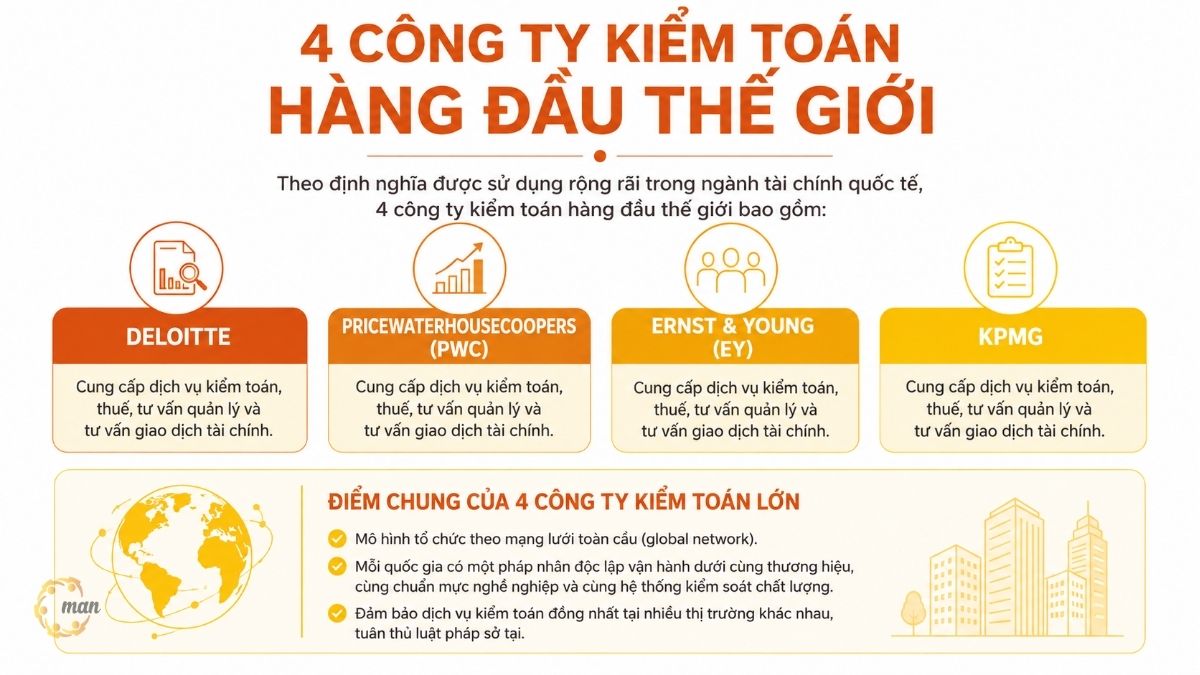
According to the definition widely used in the field of international finance, 4 auditing firms The world’s leading firms include Deloitte, PricewaterhouseCoopers (PwC), Ernst & Young (EY), and KPMG. These are four professional services firms with networks of independent member firms in most countries and territories, collectively providing audit, tax, management consulting, and financial transaction advisory services.
A common feature of these four major auditing firms is their global network organizational model, in which each country has an independent legal entity operating under the same brand, the same professional standards, and the same quality control system. As a result, a multinational corporation can utilize consistent auditing services across various markets while ensuring compliance with local laws.
The History of the Big 4's Formation
Initially, the global auditing market was dominated by eight major firms, known as the Big 8. Through a series of mergers in the 1980s and 1990s, the number decreased to the Big 6 and then the Big 5. In 2002, following the Enron financial fraud scandal, Arthur Andersen collapsed, officially reducing the group to the four auditing firms that exist today.
Deloitte traces its origins to 1845 in London, while PwC was formed through the merger of Price Waterhouse and Coopers & Lybrand in 1998. With a history spanning more than a century, all four major audit firms have professional standards and quality control processes that have been developed over many decades of practical experience.
Why do only the world’s top four audit firms dominate the global market?
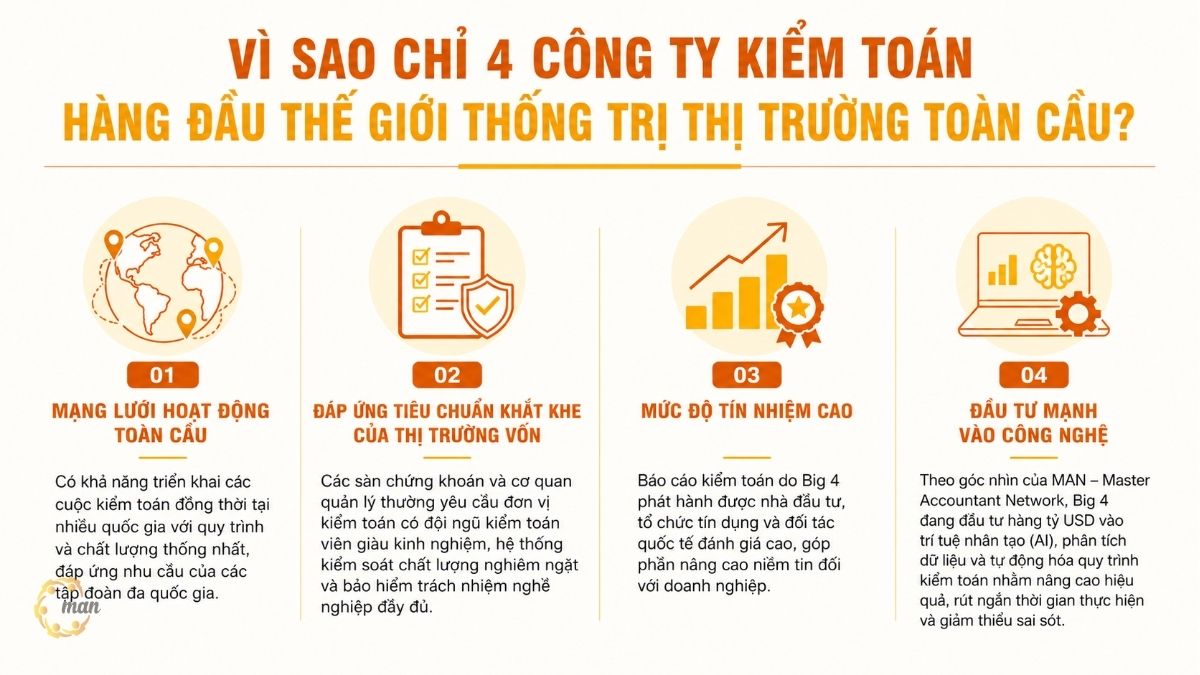
The Big 4’s leading position stems not only from their long history of development but is also built on advantages that very few audit firms can match. The combination of a global network, credibility in the capital markets, and the ability to invest in technology has created significant barriers to entry.
- Global Network: Capable of conducting simultaneous audits in multiple countries with consistent processes and quality standards, meeting the needs of multinational corporations.
- Meeting the capital market’s stringent standards: Stock exchanges and regulatory agencies typically require audit firms to have a team of experienced auditors, a rigorous quality control system, and adequate professional liability insurance.
- High level of trust: Audit reports issued by the Big 4 are highly regarded by investors, financial institutions, and international partners, helping to build confidence in the company.
- Heavy investment in technology: According to MAN—the Master Accountant Network—the Big 4 are investing billions of dollars in artificial intelligence (AI), data analytics, and audit process automation to improve efficiency, shorten turnaround times, and minimize errors.
What will the Big 4's revenue and headcount be like in 2025?
At the close of fiscal year 2025, the Big 4’s total global revenue reached a record high of over $220 billion, up 4% from the previous year, with a total workforce exceeding 1.5 million people worldwide. This is the highest revenue level in the history of the auditing industry to date.
In terms of revenue, Deloitte continued to lead with $70.5 billion, up nearly 5%. PwC ranked second with $56.9 billion, up 3%. EY reached $53.2 billion, up 4%, while KPMG ended the year with $39.8 billion, up 5%—the highest growth rate in the group.
| Auditing Firm | Global Revenue for FY2025 | Growth compared to FY2024 | Key Service Strengths |
| Deloitte | 70.5 billion USD | +5% | Management Consulting, Digital Transformation, Financial Accounting |
| PwC | 56.9 billion USD | +3% | Auditing, IFRS Reporting Transition Consulting, Valuation |
| EY | 53.2 billion USD | +4% | Tax, Technology, Financial Transaction Advisory Services |
| KPMG | 39.8 billion USD | +5% | Operational consulting, business consulting, legal consulting |
Notably, 2025 also saw a trend of workforce restructuring at several major audit firms. PwC reduced its global workforce for the first time since the 2008 financial crisis, as its global chairman decided to shift the focus from expanding headcount to improving productivity and service quality amid the impact of artificial intelligence on how the industry operates.
How do the world’s four leading audit firms differ from one another?
Although they all belong to the Big 4, each audit firm has its own year of establishment, headquarters, and service focus. The table below summarizes the most basic criteria so that readers can quickly compare them before delving deeper into each firm in the Vietnamese market.
| Criteria | Deloitte | PwC | EY | KPMG |
| Year of establishment | 1845 | 1998 (traced back to 1849) | 1989 | 1987 |
| Global Headquarters | London, England | London, England | London, England | Amstelveen, Netherlands |
| Global Revenue for FY2025 | 70.5 billion USD | 56.9 billion USD | 53.2 billion USD | 39.8 billion USD |
| Service Strengths | Management Consulting, Digital Transformation | Auditing, Valuation, IFRS Conversion | Tax, Financial Transactions, M&A | M&A Advisory, Risk Management, Legal Services |
| Year of Entry into Vietnam | 1991 (through VACO) | 1994 | 1992 | 1994 |
Looking at the comparison table of the world’s top four audit firms, it is clear that Deloitte has the longest history and also leads in global revenue, while KPMG—though the smallest in the group—is the only audit firm headquartered outside the United Kingdom. In terms of when they entered the Vietnamese market, Deloitte was the first to establish a presence through a partnership with the Vietnamese audit firm VACO, while KPMG was the last of the four major audit firms to enter the domestic market.
How did the world's top four auditing firms come to operate in Vietnam?
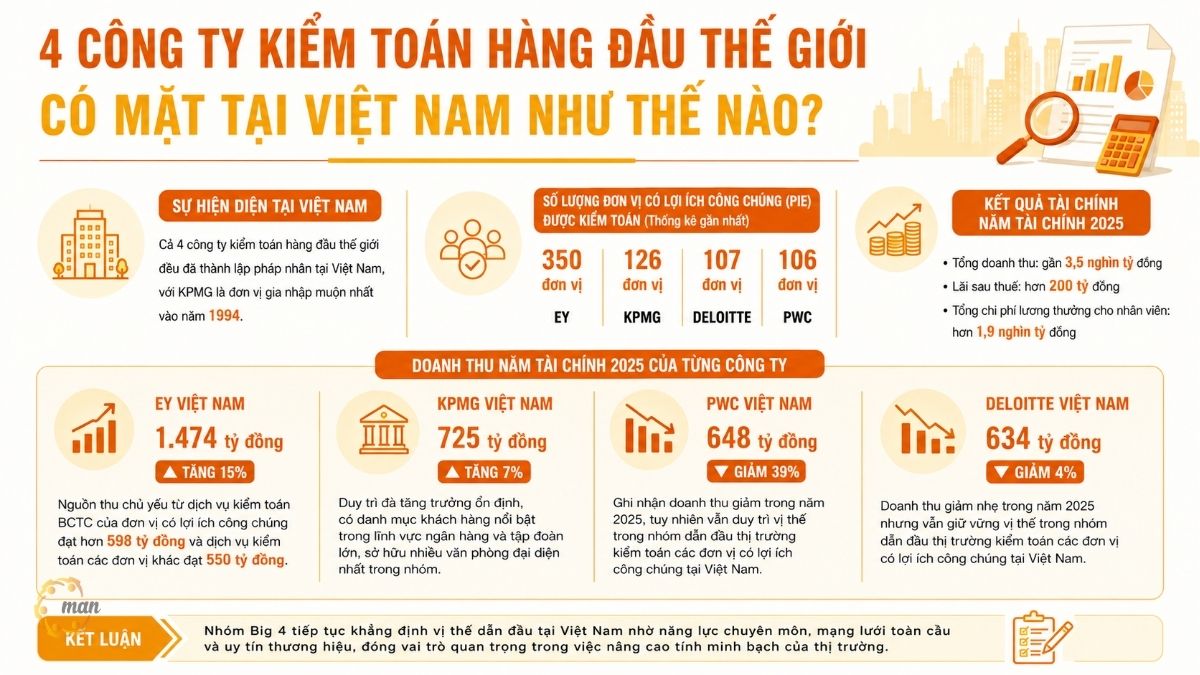
All four of the world’s leading audit firms have established legal entities in Vietnam, with KPMG being the last to enter the market in 1994. According to the latest statistics, EY has completed audits for 350 public interest entities (PIEs) in Vietnam, KPMG for 126, while Deloitte and PwC have audited 107 and 106, respectively.
In fiscal year 2025, the Big 4 firms in Vietnam generated total revenue of nearly 3.5 trillion VND and after-tax profit of over 200 billion VND—the highest level in the past three years. Total payroll and bonus expenses for employees amounted to over 1.9 nghìn tỷ đồng, accounting for the largest portion of these audit firms’ operating expenses.
- EY Vietnam: EY reported revenue of nearly 1,474 tỷ đồng in 2025, an increase of 15% compared to the previous year—the strongest growth rate in the group. The primary sources of revenue were audit services for financial statements of public-interest entities, totaling over 598 tỷ đồng, and audit services for other entities, totaling 550 tỷ đồng.
- KPMG Vietnam: KPMG has maintained steady growth, with revenue exceeding 725 billion VND, up 7%. The firm has a prominent client portfolio in the banking sector and among large conglomerates, and operates the largest number of representative offices among the top four audit firms in Vietnam.
- PwC and Deloitte Vietnam: In contrast to EY and KPMG, PwC and Deloitte reported a decline in revenue in 2025. PwC reported 648 billion VND, down 39%, while Deloitte reported 634 billion VND, down 4%. Nevertheless, both firms maintained their positions among the market leaders in auditing public-interest entities in Vietnam.
What laws and regulations govern the operations of auditing firms in Vietnam?
Legal Framework for Operations independent audit In Vietnam, there have been many significant changes during the 2025–2027 period, directly affecting the way major auditing firms as well as domestic businesses.
| Legal documents | Number / Date of Issue | Related content |
| Law Amending the Law on Independent Auditing | Law No. 56/2024/QH15, effective January 1, 2025 | Strengthen government oversight and enforce stricter professional discipline in the auditing profession |
| Decree 90/2025/ND-CP | April 14, 2025 | Add criteria for large enterprises required to have their financial statements audited |
| Circular 99/2025/TT-BTC | Effective January 1, 2026 | Issuance of new corporate accounting standards to replace previous regulations |
| Circular No. 42/2025/TT-NHNN | Effective January 1, 2026; applies starting in fiscal year 2027 | Regulations on the Independent Audit of Financial Statements and Services to Ensure the Effectiveness of Internal Control Systems at Credit Institutions |
| Decree No. 132/2026/ND-CP | Effective May 21, 2026 | Amendments to Regulations on Administrative Penalties for Violations in the Fields of Accounting and Independent Auditing |
According to Decree 90/2025/NĐ-CP, large enterprises are subject to mandatory audits if they meet at least two of the following three criteria: an annual average number of employees enrolled in social insurance exceeding 200, total revenue exceeding 300 billion VND, or total assets exceeding 100 billion VND. This regulation significantly expands the pool of potential clients for both large auditing firms and auditing firms small and medium-sized enterprises in Vietnam.
Experts at MAN – Master Accountant Network Note that Circular 42/2025/TT-NHNN, although it applies only to credit institutions that are cooperatives, reflects a general trend: regulatory authorities are expanding the scope of independent audit requirements to include internal control systems as well, rather than limiting them to financial statements alone.
Case Study: How Do Listed Companies in Vietnam Choose an Audit Firm?
Background
A publicly traded manufacturing company listed on the HOSE, with a market capitalization of approximately 2,000 tỷ đồng, is preparing to convert its financial statements to IFRS in accordance with the Ministry of Finance’s roadmap. Management needs to choose among four of the world’s leading audit firms and several domestic audit firms.
The evaluation process
According to advice from MAN—Master Accountant Network—companies should evaluate three criteria: experience with IFRS transitions in the same industry, audit fees relative to the budget, and the ability to provide cross-border support if the company plans to list internationally. The company in the case study selected one of the Big Four audit firms based on its experience with IFRS conversions for similar manufacturing companies in the region.
The measured results
- The process of converting the financial statements to IFRS was completed on schedule, and no material discrepancies were found during the State Securities Commission’s review.
- Audit costs in the first year are approximately 30–40% higher than those of a domestic audit firm, but the company saves on the cost of separate transition consulting services.
- The audit report was highly regarded by foreign investors, directly supporting the company’s next round of fundraising.
Expert Analysis: Common Business Risks When Working with an Audit Firm
Experts at MAN – Master Accountant Network With more than 30 years of hands-on experience in the Vietnamese market, we have identified three common risks that businesses often face when working with large auditing firms or auditing firm domestically.
Risk 1: Confusion between mandatory audit services and tax advisory services
Many businesses believe that signing a contract with one of the world’s top four audit firms means that all tax risks are handled. In reality, financial statement audit services and tax optimization advisory services in Vietnam are two distinct scopes of work that require separate contracts and scope of work statements.
Risk 2: Incomplete documentation prior to the audit
This is a common reason why audits take longer and incur additional costs. Businesses need to have all employment contracts, timesheets, invoices, supporting documents, and relevant internal decisions ready before the audit team begins its work.
Risk 3: Changing the audit firm without following the proper procedures
Switching from a Big 4 audit firm to another firm requires compliance with regulations on auditor rotation and disclosure requirements for publicly traded companies. MAN—Master Accountant Network—recommends developing an audit transition plan at least one quarter in advance to avoid disruptions to the financial reporting process.
Explanations of Related Technical Terms
- PIE (Public Interest Entity): Entities of public interest, including publicly traded companies, financial institutions, and insurance companies, must be audited by a qualified audit firm listed in the annually published roster.
- Non-PIE: entities that do not belong to the public interest group but are still subject to mandatory audits under the regulations governing large enterprises.
- IFRS (International Financial Reporting Standards): International Financial Reporting Standards, which many Vietnamese companies are in the process of adopting.
- Big 4: The common names for the world’s four leading audit firms, as distinguished from the group of medium- and small-sized audit firms (Non-Big 4) such as Grant Thornton, BDO, RSM, Crowe Global, and Mazars.
What is the path for students and accountants to join the world’s top four audit firms?
There is no single path to joining one of the world’s top four audit firms, but most successful candidates go through three stages: building an academic foundation, earning professional certifications, and navigating a rigorous recruitment process. Below is a specific roadmap tailored to each group.
First- and Second-Year College Students: Building a Foundation
- Enroll in a major in Accounting, Auditing, Finance, or Economics at universities that have educational partnerships with international programs.
- Invest in a solid foundation in English, aiming for a minimum IELTS score of 6.5 or higher, as all four major audit firms regularly work with clients and handle documents in English.
- Start exploring professional certifications such as ACCA (Association of Chartered Certified Accountants) or ICAEW to create a study plan that runs parallel to your undergraduate program.
- Join academic clubs and participate in accounting and auditing competitions organized by universities or major auditing firms to familiarize yourself with corporate culture.
Third- and fourth-year college students: gaining practical experience
- Apply for internship programs or young talent development programs (such as Deloitte Passport and PwC Fast Track) organized annually by major auditing firms; applications typically open in the middle of the year.
- Complete at least the first few courses of the ACCA or CPA Vietnam program to gain a competitive edge when applying.
- Hone your Excel, data analysis, and teamwork skills, as these are the skills that are evaluated throughout the interview process at an auditing firm.
- Prepare your resume and cover letter in English, and practice the types of aptitude tests commonly used by the Big 4 firms.
Common Hiring Processes at the Big Four Audit Firms
According to reports from MAN – Master Accountant Network Based on our experience working with many candidates and companies, the recruitment process at major auditing firms typically consists of four steps: submitting an online application, taking aptitude and English proficiency tests, participating in a group discussion or case study, and a face-to-face interview with the HR department and the responsible partner. Each round has a relatively high rejection rate, requiring candidates to prepare thoroughly well in advance.
Career Development Path After Being Hired
The hierarchical structures at the world’s top four auditing firms are quite similar, typically following this sequence: Associate, Senior Associate, Assistant Manager, Manager, Senior Manager, Director, and finally Partner. The average time to advance to each level ranges from 2 to 3 years, depending on individual ability and the completion of professional certifications during employment.
Career Path for Working Accountants and Auditors
For those with experience at a domestic auditing firm or in a corporate accounting department, opportunities to transition to one of the Big Four accounting firms remain wide open if they meet the qualifications. The Certified Public Accountant (CPA Vietnam) certification, issued by the Ministry of Finance in accordance with the Law on Independent Auditing, is a significant advantage, in addition to 2–3 years or more of practical experience in financial statement auditing or tax consulting.
The solution offered by MAN—the Master Accountant Network—for this group is to proactively stay up to date on International Financial Reporting Standards (IFRS) while building a portfolio that clearly demonstrates their experience in managing tax and audit risks for businesses of a similar size to those served by the Big 4 firms.
Conclude
The world’s top four audit firms are not only familiar names to finance students but also strategic partners to thousands of businesses in Vietnam, particularly as the legal framework for independent auditing continues to be updated during the 2025–2027 period. A proper understanding of the role, strengths, and process for selecting the right audit firm helps businesses optimize costs and minimize risks when working with government regulatory agencies.
MAN – Master Accountant Network We are a tax, accounting, and auditing firm with a team of experts who have over 30 years of practical experience and a deep understanding of tax risk management in the Vietnamese market. We provide a full range of auditing services, tax consulting, tax accounting, and financial reporting for foreign-invested enterprises (FIEs), domestic businesses, and individuals, supporting clients through each tax filing period. For specific advice tailored to your business’s situation, please contact MAN – Master Accountant Network.
Service contact information at MAN – Master Accountant Network
- Address: No. 19A, Street 43, Tan Thuan Ward, Ho Chi Minh City
- Mobile/Zalo: 0903 963 163 – 0903 428 622
- E-mail: man@man.net.vn
- Google Business Profile: View MAN – Master Accountant Network's Google Business Profile
- LinkedIn Founder: View expert Le Hoang Tuyen's LinkedIn profile.
Responsible for production and professional content review by: Mr. Le Hoang Tuyen – Founder & CEO of MAN – Master Accountant Network, CPA Vietnam with over 30 years of experience in accounting, auditing, taxation, and corporate financial consulting.
Frequently Asked Questions About the World's Top 4 Audit Firms
Which companies make up the world's top four audit firms?
These include Deloitte, PwC, EY, and KPMG. All four have networks of member firms in most countries, including Vietnam.
What will be the revenue of the world’s four largest auditing firms in 2025?
Total global revenue exceeded $220 billion. Deloitte led the pack with $70.5 billion, followed by PwC, EY, and KPMG.
Which auditing firm has the highest revenue in Vietnam?
According to the most recent data released, EY leads the Vietnamese market in revenue for 2025, with a growth rate of 15%.
Which businesses are required to be audited by major auditing firms?
Under current regulations, public companies, credit institutions, enterprises with foreign investment, and large-scale enterprises that meet the criteria set forth in Decree 90/2025/NĐ-CP are all subject to mandatory auditing; however, they are not required to select a large auditing firm unless they are entities of public interest.
Is it possible to use an audit firm outside the Big 4?
Yes. Entities that are not classified as public interest entities may certainly select a domestic audit firm, provided that the firm is qualified to provide audit services in accordance with the law.