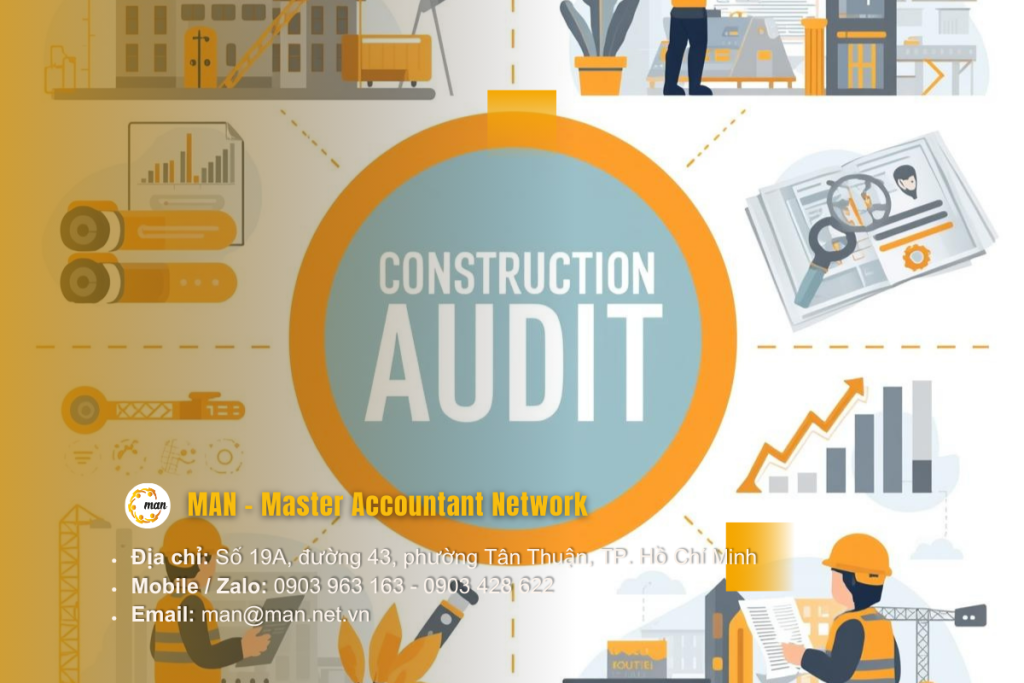
Construction auditing is a crucial function in financial control and risk management, especially for large, complex, and long-term construction projects. This activity ensures that all investment capital, from state budget to private capital, is used efficiently, for its intended purpose, and in compliance with the law. As an independent "gatekeeper," construction auditing provides the necessary transparency, giving investors peace of mind regarding the effective management of capital and the fulfillment of legal obligations according to current regulations.
Public spending on construction projects accounts for a large proportion of the budget, creating an urgent need for settlement and control. Construction auditing is an important tool that helps investors complete settlement documents according to regulations. Circular 10/2020/TT-BTC and provides a basis for determining reasonable expenses when calculating corporate income tax. Conducting professional audits, in compliance with Vietnamese Auditing Standards, ensures the accuracy and legality of final accounts reports, minimizes legal risks and disputes, and enhances the efficiency of investment capital management.
What is construction auditing? What is its role in the project cycle?
Construction auditing is the process of independently and objectively evaluating the financial, management, and operational activities of an investment project. In addition to reviewing accounting records, auditors also compare actual quantities, costs, contracts, and legal regulations to ensure accuracy, reasonableness, and compliance. This activity helps investors improve internal management, assess capital efficiency, prevent risks, and meet the requirements of state audits, independent audits, and internal audits throughout the entire project cycle.
Definition and nature of construction auditing
Construction auditing is the process of independently and objectively examining and evaluating the financial, accounting, management, and operational aspects of a construction investment project. Unlike typical financial statement audits, construction auditing focuses on verifying the accuracy and reasonableness of the total investment cost, implementation costs, completion documents, and compliance with regulations on construction investment cost management.

The essence of construction auditing is not just reviewing the figures in accounting books, but also includes comparing accounting data, actual construction volume at the site, and regulations in the contract, design, as well as state or local government norms and unit prices. This is an effective tool to help investors and state management agencies comprehensively assess the efficiency of capital utilization, especially budget capital or non-budget state capital.
The core objective of construction auditing.
Construction audits are conducted to achieve the following main objectives:
Ensuring the accuracy and reasonableness of investment costs.
The primary objective is to verify whether all costs incurred in acquiring fixed assets after project completion have been accurately and reasonably recorded. This includes checking the correctness of the work volume, applicable unit prices, project management costs, consulting fees, and other related expenses. Any discrepancies or errors in accounting and settlement are promptly detected through the construction audit process.
Confirm compliance with laws and contracts.
Construction audits play a crucial role in verifying that a project has fully complied with current legal regulations regarding construction, bidding, cost management, accounting, taxation, and the terms of signed economic contracts. This compliance is especially important for projects using state budget funds, where violations can lead to serious legal consequences.
Improving the efficiency of capital management and utilization.
Through the evaluation of internal management processes, construction audits provide valuable recommendations to help investors and project management improve operational efficiency, optimize costs, and prevent waste. This is an aspect of operational auditing that is deeply integrated into the basic construction audit process.
Classification of common types of construction audits
Based on the entity performing the audit and the specific purpose, construction auditing activities can be classified into three main forms:
State audit of construction (for budget-funded projects)
State audits are conducted on projects using state capital and assets. The objective is to verify the accuracy and integrity of the final accounts report and to assess the socio-economic effectiveness of the management and use of investment capital. The scope of the audit is very broad, encompassing the economic viability, efficiency, and effectiveness of the project.
Independent audit of construction investment projects
This is performed by private auditing firms that are qualified to practice under the Independent Auditing Law. This form of auditing serves the needs of project owners (for projects requiring mandatory auditing before final settlement approval according to regulations) or other stakeholders (such as lending banks, investors). This is the most common type of construction auditing in the market.
Internal auditing in the construction sector
Performed by the company's own internal audit department. The primary purpose is to assess risks, improve internal management processes, ensure policy compliance, and prevent fraud and errors in project management.
Legal basis and standards for conducting construction audits.
To ensure legality and reliability, all construction audit activities must be based on a strict system of legal documents and professional standards.
The legal framework serving as the basis for auditing.
The Vietnamese legal system provides very clear regulations on cost management and project settlement for construction investment projects. Auditors conducting construction audits need to have a thorough understanding of:

- The Construction Law No. 50/2014/QH13 and its guiding documents (such as Decree 10/2021/ND-CP on the management of construction investment costs): These are the basic basis for determining acceptable quantities, norms, and unit prices.
- Vietnamese Accounting Law and Accounting Standards (VAS): Regulations on the principles for recognizing and accounting for investment expense items.
- Circular 96/2015/TT-BTC and its amendments and supplements: Regulations on determining deductible expenses when calculating corporate income tax. Construction auditing helps investors prepare transparent documentation for tax authorities.
- Circular 10/2020/TT-BTC on the final settlement of completed projects funded by state capital: This is the most direct regulation regarding the documentation and approval process for final settlement, and the inclusion of an independent construction audit report (if any) as a mandatory component.
Proper application of these legal documents is crucial for ensuring that construction audit reports have the highest legal validity and meet the requirements of state agencies and tax authorities.
National and Sectoral Auditing Standards
Independent construction audits are conducted based on the Vietnamese Auditing Standards (VSA) issued by the Ministry of Finance. In particular, the standards related to gathering audit evidence (VSA 500), planning (VSA 300), and obtaining audit opinions (VSA 700) form the foundation.
However, due to the specialized nature of the construction sector, auditors need to apply in-depth inspection techniques and procedures that go beyond the scope of simple financial auditing, focusing on: assessing legal and technical documentation, and comparing them with actual conditions. This process requires auditors to be not only proficient in accounting and auditing but also to have extensive knowledge of construction standards, unit prices, and technical procedures.
A thorough construction audit process ensures
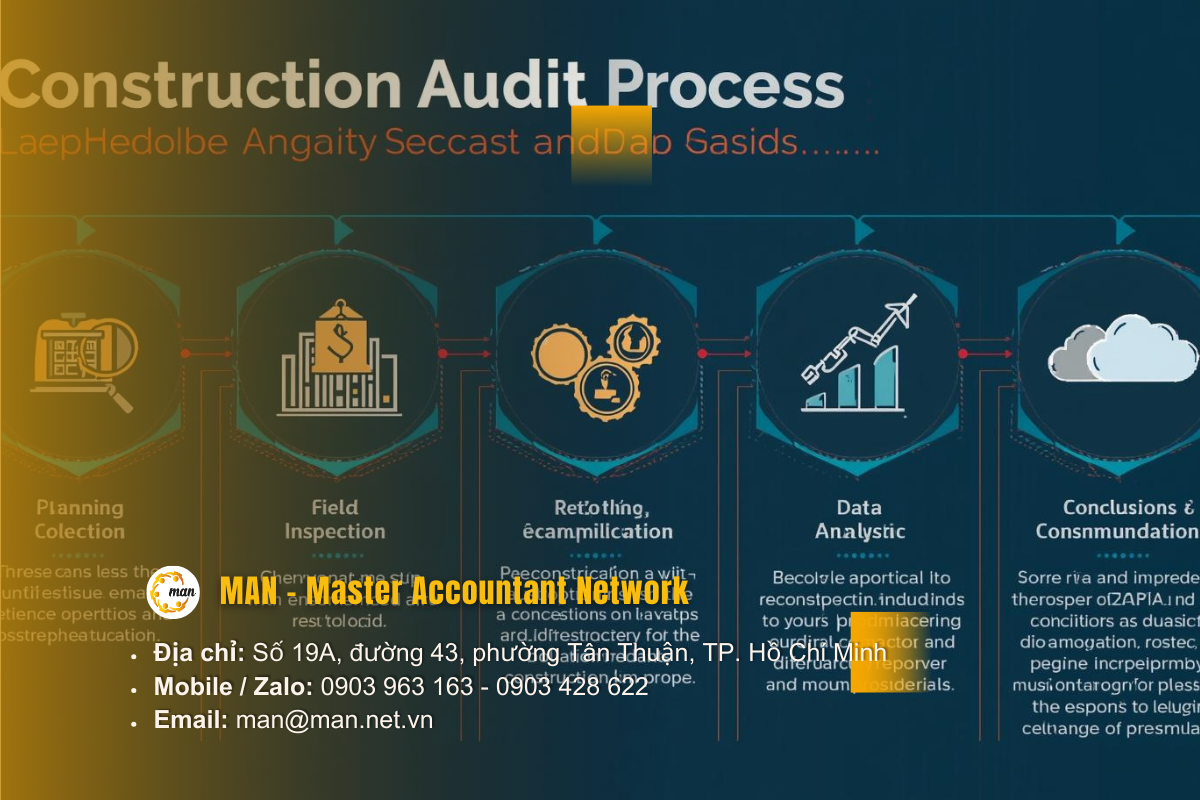
A professional, compliant construction audit process is carried out in four main stages, ensuring the comprehensiveness and reliability of the results.
Phase 1: Planning and Risk Assessment
This is the foundational stage that determines the quality of a construction audit.
Receiving and conducting a preliminary assessment of project documents.
The auditor receives all legal documents of the project, including the investment decision, basic design, feasibility study report, signed economic contracts, and related accounting records. The goal is to gain a thorough understanding of the project's scale, funding sources, management mechanisms, and stakeholders.
Construction audit risk analysis
Auditors identify areas with the highest risk of material misstatement. These risks typically include:
Develop a detailed audit program.
Based on the risk assessment results, auditors develop a detailed audit program, determining the scope of examination and specific audit procedures for each cost item (such as survey costs, design costs, construction costs, equipment costs, and contingency costs). This plan must be flexible and adjustable during the construction audit process.
Phase 2: Gathering and evaluating evidence
During this phase, auditors conduct in-depth audit procedures.
Review legal documents and contracts.
Verify the completeness and validity of legal documents (construction permits, project approval decisions, etc.). In particular, examine the terms of economic contracts, contract addendums, and negotiation minutes to ensure the legal binding nature of completed transactions.
Verification of capital construction investment costs (direct costs)
This is the most important part of a construction audit. The auditor performs the following:
- Quantity verification: Compare the actual work volume with the design drawings, cost estimates, and acceptance reports (completion documents). This verification step requires a deep understanding of construction engineering.
- Checking unit prices: Review the application of norms and unit prices for labor, materials, and machinery according to regulations of competent state agencies or reasonable market quotations.
- Check other costs: Verify whether indirect costs, project management costs, and consulting fees are calculated correctly according to the rates and standards stipulated by the Ministry of Construction and the Ministry of Finance.
Review the accounting system and cost accounting.
Ensure that expenses have been accounted for correctly, in the correct accounting period, and in accordance with Vietnamese Accounting Standards. Construction auditors must confirm that payments have been recorded correctly according to the cash principle and the accrual principle, especially advances and project warranties.
Field inspection (observation and comparison)
For complex or high-risk projects, auditors may conduct on-site inspections to observe the condition of the construction, directly comparing certain construction items with the acceptance documents. This strengthens the authenticity of audit evidence.
Phase 3: Synthesis, Conclusion, and Recommendations
After completing the evidence gathering process, the auditor proceeds to compile the results.
Identify errors and their impact.
All detected errors (in terms of quantity, unit price, accounting, and procedures) are quantified in monetary terms. The auditor calculates the impact of these errors on the total investment and the final settlement value of the project.
Drafting a construction audit report.
The draft report is prepared, detailing the scope of the audit, the methodology used, the errors and deficiencies identified, along with recommendations for correction and management. The audit report must strictly adhere to the regulations regarding the form and content of independent audit reports.
Discuss with clients and stakeholders.
Auditors discuss the draft with the project owner and project management team to ensure the findings are accurate and agreed upon. This is a crucial step in enhancing the feasibility of recommendations resulting from construction audits.
Phase 4: Release of the official report
The official construction audit report is issued after the completion of internal review procedures and approval from the investor (for issues that do not affect the audit opinion). This report is the most important legal basis for the investor to submit to the competent authority for approval of the investment capital settlement.
Key areas within the scope of construction auditing.
The scope of construction auditing is very broad, encompassing all cost items that make up the post-investment asset value.
Auditing construction and equipment costs
This item typically accounts for the largest proportion and has the highest risk of error. Construction audits focus on:
Costs of materials, labor, and construction machinery.
The auditor will review the material consumption norms, labor unit prices as stipulated in Circular 17/2019/TT-BXD, and construction machinery costs. The auditor will compare the material summary with the contract, warehouse receipt, and purchase invoice to determine their reasonableness and validity.
Completed work volume and acceptance report
Verify the accuracy of the completed work volume by comparing it with the as-built documentation, phase/item acceptance reports, and construction log. Construction audits help detect fictitious volumes, fraudulent acceptances, or acceptances that do not meet the specified standards.
| Content of the test | Audit basis | Common risks |
| Mass | Design drawings, cost estimates, and acceptance reports (contract appendices) | Acceptance testing exceeding design volume, double counting of volume. |
| Unit price | State-mandated standards (circulars, decisions), market prices at the time. | Applying incorrect standards or unit prices that are not appropriate for the time and region. |
| File | Contracts, contract addendums, invoices, payment documents | Missing invoices (expenses without invoices), missing debt reconciliation statements. |
Auditing of project management and investment consulting costs.
These costs are usually calculated as a percentage (%) of the construction and equipment costs as stipulated by the government.
Consulting fees (survey, design, supervision)
Construction audits verify the reasonableness of consulting contracts, especially supervision consulting costs, ensuring they have been calculated correctly according to Decision 79/QD-BXD (or its replacement document) and guiding circulars on cost management.
Project management costs
Verify that project management expenses (management staff salaries, office expenses, etc.) are being used for their intended purpose and within the approved budget. Any expenditure exceeding the budget must be reasonably justified and have a solid legal basis; otherwise, it will be excluded from the final settlement value by the construction auditor.
Audit the costs of compensation, assistance, and resettlement (if any).
For projects involving land, auditors must examine the legality and procedures for compensation and resettlement support in accordance with the Land Law and related decrees. The validity of documentation, compensation rates, and payment procedures are the focus of capital construction audits in this case.
Construction audits and their impact on accounting and taxation.
Construction auditing activities are closely related to and directly affect the accounting and tax filing practices of businesses.
Role in the final settlement of completed investment capital
According to Circular 10/2020/TT-BTC, an independent construction audit report is one of the mandatory documents to be submitted with the final settlement dossier of completed investment projects (for projects required to be audited). This report serves as the basis for the investor and competent authority to approve the value of fixed assets formed after investment.
Construction audits help eliminate invalid expenses (such as duplicate costs, over-budget costs, and expenses without legitimate invoices or documentation), thereby determining the most accurate final settlement value. This value serves as the basis for accounting for fixed assets in the accounting books according to Accounting Standard No. 03.
Article 37 of Decree 99/2021/ND-CP stipulates the procedures for preparing, verifying, and approving the final accounts of completed projects using public investment capital, emphasizing the role of independent audit reports. An audit report is indispensable evidence.
Construction audit and basis for determining taxes (VAT & Corporate Income Tax)
The transparency brought about by construction audits directly impacts a company's tax obligations.
VAT and invoice validity
Auditors examine the legality of the invoicing system and supporting documents (VAT invoices, receipts) to ensure that businesses can legitimately deduct input VAT. Detecting illegal or invalid invoices during the audit process will help businesses make timely adjustments, avoiding tax arrears and penalties later on.
Deductible expenses when calculating corporate income tax.
According to the Corporate Income Tax Law and its guiding documents (e.g., Circular 96/2015/TT-BTC), expenses must have legal invoices and supporting documents related to production and business activities to be considered deductible expenses. Construction audits confirm the validity of all investment expenses, ensuring that the value of fixed assets to be depreciated later (and thus included in deductible expenses) is entirely legally sound and supported by clear documentation, minimizing the risk of the expenses being rejected by the tax authorities.
Challenges and solutions to improve the effectiveness of construction audits.
Construction auditing activities always face many challenges due to the unique nature of the industry.
Challenges in the auditing process
The auditing process often faces numerous challenges. The complex technical documentation of a construction project requires auditors to possess in-depth knowledge beyond conventional accounting. Simultaneously, the constant changes in norms and unit prices, if not updated promptly, can lead to errors in final settlement. On-site inspections of completed or concealed items also present difficulties, requiring close coordination between the investor, contractor, and auditing team.
Complexity of technical documentation
Construction projects often involve a massive and complex volume of technical documentation (drawings, design specifications, detailed cost estimates). Verifying and comparing these quantities requires auditors to possess in-depth expertise in construction engineering, going beyond conventional accounting and auditing knowledge.
The diversity and variability of standards and unit prices.
The system of construction norms and unit prices is frequently adjusted by the state (according to circulars of the Ministry of Construction). Incorrect application of norms or unit prices, or failure to promptly update legal changes, poses a major challenge, leading to errors in final accounts and reducing the effectiveness of construction auditing.
Difficulties in field inspection
For completed projects or items that have been concealed, on-site inspection to verify quantities is very difficult, requiring close coordination between the owner, contractor, and auditor.
Solutions and development trends
To improve the quality of construction audits, new solutions and technologies need to be applied.
Application of BIM technology and specialized software.
The application of Building Information Modeling (BIM) technology makes it easier for auditors to compare quantities against 3D models, minimizing errors compared to reading traditional 2D drawings.

Software for verifying final accounts also helps to increase the speed and accuracy in reviewing norms and unit prices. This is an inevitable trend in construction auditing activities.
Advanced training and certification in construction auditing.
Auditing firms need to invest in training their auditors not only in financial expertise but also in technical knowledge, standards, and specialized construction laws. Possessing professional certifications (e.g., Construction Valuation Certificate, Construction Supervision Practice Certificate) is essential.
Increase the frequency of internal audits.
Project owners should strengthen internal audits throughout the project implementation process, rather than waiting until the final settlement stage. Controlling costs and procedures early on helps prevent errors and minimize the risk of cost exclusions during the final independent construction audit.
Conclude
Enhance your professional capabilities and optimize construction cost management with MAN – Master Accountant Network. We offer: auditing services and professional accounting services, including construction auditing, tax auditing, and project cost management consulting. With a team of experienced professionals, MAN helps businesses review costs, ensure legal compliance, optimize capital efficiency, and reduce risks. Simultaneously, in-depth training programs connect you with industry experts, equipping you with practical knowledge and comprehensive solutions for construction project management.
Service contact information at MAN – Master Accountant Network
- Address: No. 19A, Street 43, Tan Thuan Ward, Ho Chi Minh City
- Mobile/Zalo: 0903 963 163 – 0903 428 622
- Email: man@man.net.vn
Content production by: Mr. Le Hoang Tuyen – Founder & CEO MAN – Master Accountant Network, Vietnamese CPA Auditor with over 30 years of experience in Accounting, Auditing and Financial Consulting.