

Audited financial statements are a set of independently verified financial documents that banks, investors, and bidders always require before signing any cooperation agreement. Law No. 56/2024/QH15 With the amendment to the Law on Independent Auditing, effective from January 1, 2025, the scope of businesses required to undergo audits has been significantly expanded, leading to a strong increase in the need for businesses and investors to properly understand the nature of this type of report.
For businesses preparing for tenders, loans, or investment fundraising, a set of audited financial statements, bearing the auditor's seal and signature, is the strongest legal evidence of data accuracy. This article, compiled from the perspective of... MAN – Master Accountant NetworkProviding comprehensive answers, from definitions and legal basis to implementation procedures.
| Audited financial statements are a set of financial reports that have been examined and verified by independent auditors to ensure the accuracy and reasonableness of the data. |
| What is it used for? To demonstrate financial transparency to banks, investors, tax authorities, and bidding parties. |
| Applicable to: FDI enterprises, public companies, credit institutions, state-owned enterprises, and (from 2025) large-scale enterprises as defined in Decree 90/2025/ND-CP. |
| When needed: when preparing annual financial statements, when participating in tenders, borrowing capital, or as required by law. |
| Main legal basis: Law on Independent Auditing 2011, Law No. 56/2024/QH15, Decree 17/2012/ND-CP and Decree 90/2025/ND-CP. |
What constitutes an audited financial statement according to legal regulations?
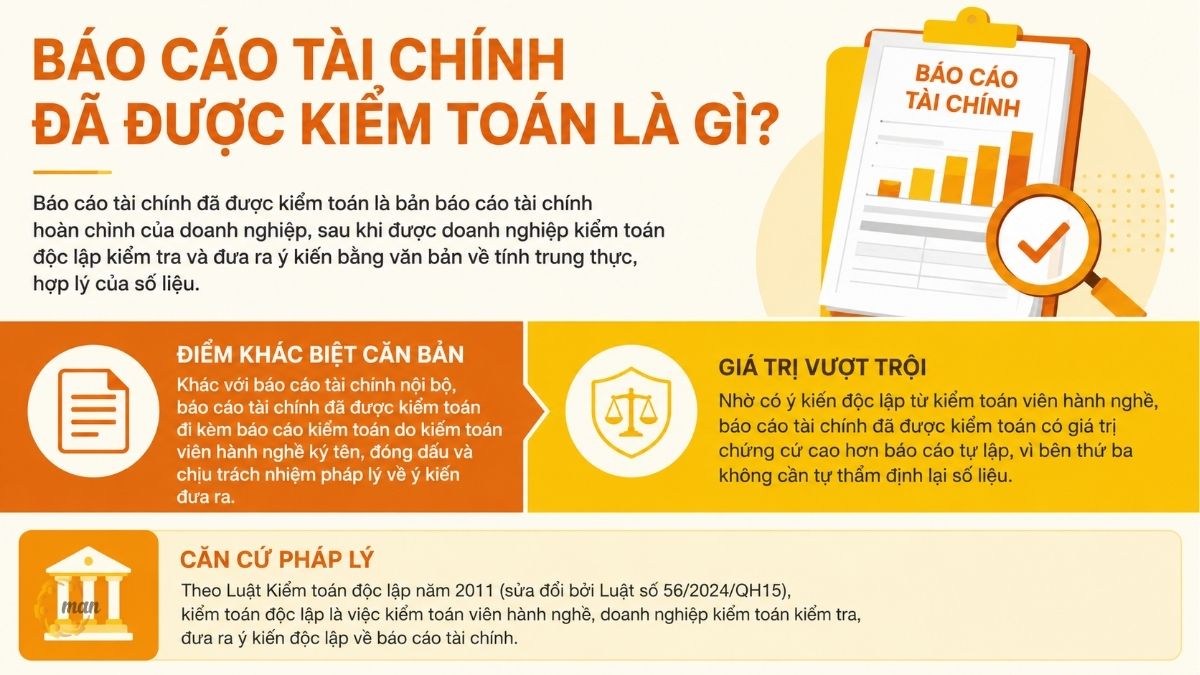
Audited financial statements are the complete financial reports of a business, after being examined by an independent auditing firm which provides a written opinion on the fairness and accuracy of the data. The fundamental difference from internal financial statements is that they are accompanied by an audit report signed and stamped by a practicing auditor, who is legally responsible for the opinion expressed.
According to Independent Auditing Law of 2011 (Amended by Law No. 56/2024/QH15), independent auditing is the process by which practicing auditors and auditing firms examine and provide independent opinions on financial statements. As a result, audited financial statements have higher evidentiary value than self-prepared reports, because third parties do not need to re-evaluate the data themselves.
Distinguishing between regular financial statements and audited financial statements.
Financial statements prepared by accountants only reflect an internal view and have not undergone independent verification. Audited financial statements go through three stages: planning, performing audit procedures on-site, and compiling and issuing an opinion. The result may be unqualified, qualified, a qualified opinion, or a disclaimer of opinion.
This difference determines the legal validity: a bank loan agreement or an international tender document will almost certainly not accept unaudited financial statements if the business is required, or voluntarily chooses, to demonstrate its financial capacity.
Why are audited financial statements important to businesses and investors?
For investors, audited financial statements are the basis for accurately assessing a company's financial health before investing, minimizing the risk of information asymmetry. For banks, this is mandatory documentation in credit assessment, directly affecting loan limits and applicable interest rates.
From this perspective MAN – Master Accountant NetworkOver more than 30 years of providing audit consulting services to FDI and domestic enterprises, many bidding documents have been rejected in the preliminary selection round simply because the financial statements were not audited or had expired. This is a risk that can be completely avoided if businesses proactively plan for audits early.
Beyond its "proof-making" function, audited financial statements help management detect accounting errors, potential fraud, or weaknesses in internal controls—issues that internal accounting departments sometimes struggle to identify on their own.
Which businesses are required to have audited financial statements?
Not all businesses are required to have their financial statements audited annually, but the list of required entities has expanded significantly since 2025. This is in accordance with the Independent Auditing Act (amended) and... Decree 90/2025/ND-CPThe following groups are required:
- Foreign invested enterprises (FDI).
- Credit institutions and branches of foreign banks in Vietnam.
- Financial institutions, insurance companies, reinsurance companies, insurance brokers.
- Public companies, securities issuers, and securities trading organizations.
- State-owned enterprises as defined by the Enterprise Law.
- Enterprises and organizations implementing nationally important projects and Group A projects using state capital.
Notable new features: Decree 90/2025/ND-CP The category of "other large-scale enterprises" has been added to the list of mandatory audits. An enterprise is considered large-scale if it meets at least two of three criteria: Total assets: 100 billion VND or more; Total revenue: 300 billion VND or more; Number of employees: 200 or more (participating in social insurance).
Businesses that fail to meet the large-scale criteria for two consecutive years are temporarily exempt from mandatory audits until they meet the criteria again.
See more articles at: Top 10 Reputable and Professional Auditing Service Companies in Ho Chi Minh City
What documents are included in an audited financial statement?
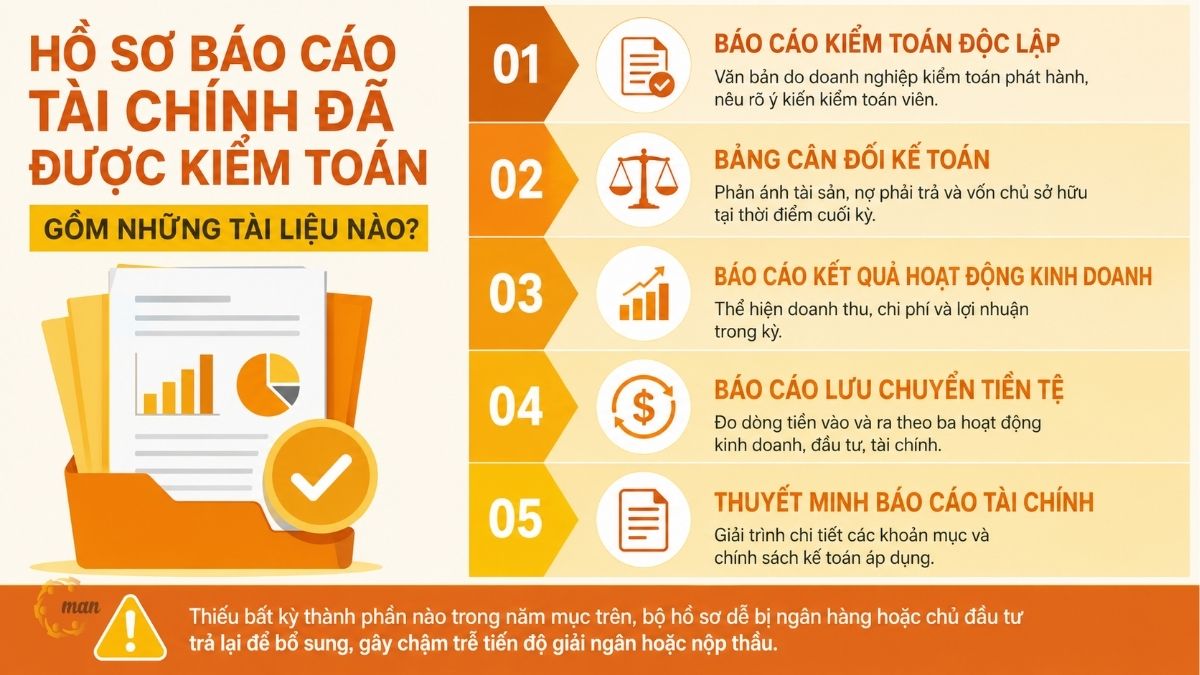
A complete and properly audited set of financial statements to submit to a bank or tenderer typically includes five components:
- Independent audit report: A document issued by the auditing firm, stating the auditor's opinion.
- Balance sheet: reflects assets, liabilities, and equity at the end of the period.
- Business performance report: shows revenue, expenses, and profit for the period.
- Cash flow statement: Measures cash inflows and outflows across three business activities: operating, investing, and financing.
- Explanatory notes to the financial statements: Provide a detailed explanation of the accounting items and policies applied.
Missing any of the five components above, the application is likely to be returned by the bank or the investor for further information, causing delays in disbursement or bidding.
What is the process for auditing financial statements?
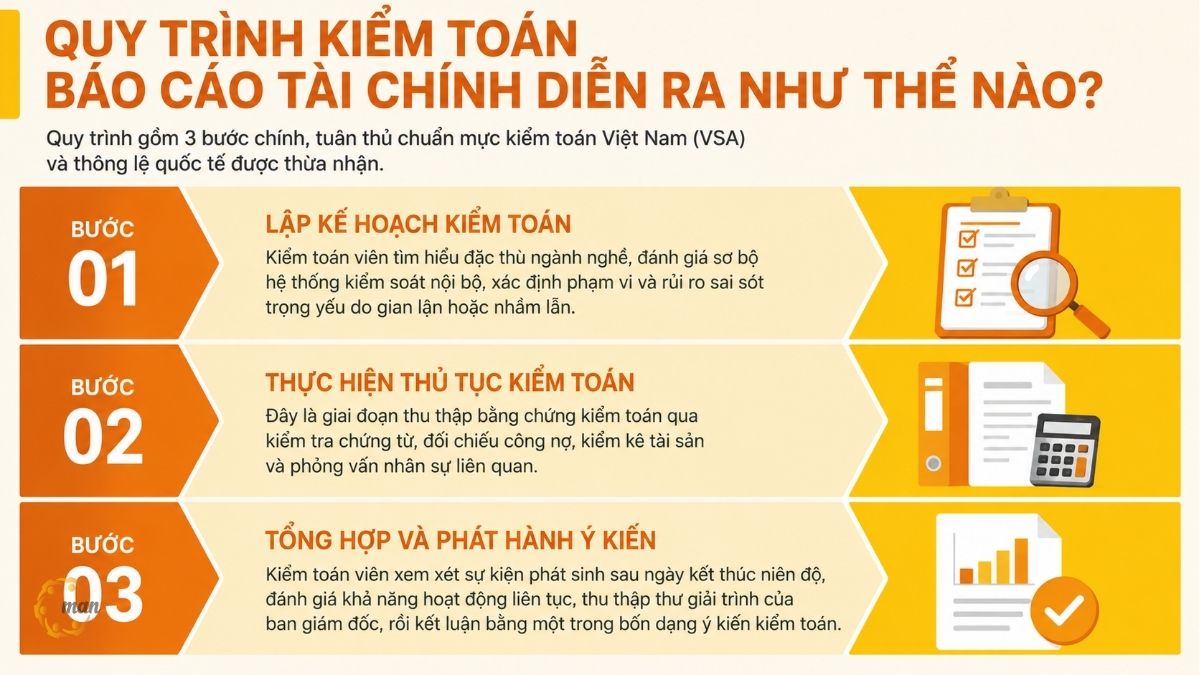
The process for creating one financial reports The audit was conducted in three main steps, complying with Vietnamese Auditing Standards (VSA) and recognized international practices:
- Step 1: Develop an audit plan. Auditors understand the specifics of the industry, conduct a preliminary assessment of the internal control system, and determine the scope and risk of material misstatement due to fraud or error.
- Step 2: Perform the audit procedure. This stage involves gathering audit evidence through document examination, debt reconciliation, asset inventory, and interviews with relevant personnel.
- Step 3: Summarize and disseminate feedback. Auditors review events occurring after the year-end date, assess the going concern status, obtain written statements from management, and then conclude with one of four types of audit opinions.
See more articles at: Reputable auditing firms: Top 15 leading firms and solutions from MAN
Compilation of legal documents related to audited financial statements.
Important note: Businesses need to review their size criteria based on data from the immediately preceding year to accurately determine whether they are subject to mandatory financial statement audits, avoiding penalties for failing to fulfill their obligations.
| Legal documents | Number / Date of Issue | Related content |
| Law on Independent Auditing | Resolution No. 67/2011/QH12, effective January 1, 2012 | Fundamental regulations on independent auditing activities and entities subject to mandatory auditing. |
| Law amending and supplementing the Law on Independent Auditing | Resolution No. 56/2024/QH15, dated November 29, 2024, effective January 1, 2025 | Adding "large-scale enterprises" to the list of those required to undergo audits increases the state's oversight authority. |
| Decree 17/2012/ND-CP | March 13, 2012 | Detailed guidelines for implementing the Law on Independent Auditing. |
| Decree 90/2025/ND-CP | April 14, 2025 | Adding criteria for identifying large-scale enterprises; limiting the number of consecutive years for submitting audit reports to 5 years. |
| Circular 200/2014/TT-BTC | December 22, 2014 | Guidelines for corporate accounting system and financial reporting forms. |
How to determine if a business is subject to mandatory auditing – A practical example.
This is where many accountants make the biggest mistake when applying the new regulations. Not all large businesses are automatically required to be audited in the current year; the requirements must be based on the data from the immediately preceding year.
Here's a specific example calculation:
Company B has an average of 250 employees participating in social insurance in 2025, total assets of VND 120 billion, and total revenue of VND 280 billion. The company meets 2 out of 3 criteria (employees and total assets), therefore a mandatory audit of its 2026 financial statements is required. If the company fails to meet both criteria consecutively in 2027 and 2028, it will be temporarily exempt from mandatory auditing from 2029 until it meets the criteria again.
| Criteria | Applicable threshold | How to determine |
| Average number of workers participating in social insurance per year | Over 200 people | The total number of workers participating in social insurance in the previous year divided by 12. |
| Total annual revenue | Over 300 billion VND | Based on the financial statements of the immediately preceding year. |
| Total assets | Over 100 billion VND | Determined at the end of the immediately preceding fiscal year. |
Case Study: A manufacturing company in Dong Nai prepares documents for an international tender.
Background
Company Y (a manufacturer of industrial packaging, with an annual revenue of 280 billion VND and 210 employees covered by social insurance) in Dong Nai wants to participate in a tender to supply a foreign corporation. The tender documents require audited financial statements for the past 12 months.
Practical handling
According to advice from MAN – Master Accountant Network, the company takes 3 steps: (1) Review large-scale criteria according to Decree 90/2025/ND-CP; (2) Select an audit firm and agree on a plan 45 days before submitting the bid; (3) Prepare documents, reconcile liabilities and fixed assets before the auditors come to work on-site.
The measured results
- The audit report was released on time, 10 days before the bid deadline.
- The company's financial documents were deemed satisfactory by the bidding party during the pre-qualification round, requiring no further explanation.
- Early preparation allows the company to detect and adjust a discrepancy in fixed asset depreciation before the official report is released, avoiding qualified opinions.
Expert opinion: Common business risks when preparing audited financial statements.
Experts at MAN – Master Accountant Network With over 30 years of practical experience in tax risk management and auditing in Vietnam, we note the four most common risks:
- Risk 1: Preparing for the audit too close to the filing deadline: Many businesses only contact auditors when their tender or loan application deadlines are approaching, leaving auditors insufficient time to gather adequate evidence, which can easily lead to qualified opinions or delays in report issuance.
- Risk 2: Confusion between self-prepared financial statements and audited financial statements: Some businesses submitted financial reports bearing the company seal but which had not undergone independent auditing, resulting in their applications being rejected in the initial screening round because they did not meet the legal requirements of the receiving party.
- Risk 3: Missing mandatory audit obligations based on large-scale criteria: Since Decree 90/2025/ND-CP came into effect, many businesses that are not FDI companies or public companies have unexpectedly fallen under the mandatory audit category due to meeting the large-scale criteria but failing to conduct timely reviews, leading to the risk of administrative penalties.
- Risk 4: Incomplete documentation and records when the auditor begins work: The lack of accounts receivable reconciliation statements, asset inventory records, or explanatory letters from the board of directors are common reasons why audits are prolonged and unexpected costs are incurred.
Conclude
Audited financial statements are not only a legal requirement for certain groups of businesses, but also a tool for building credibility with banks, investors, and bidding partners. Proactively review your obligations. audit For large-scale businesses, preparing documentation early and choosing a suitable auditing firm will help them avoid unnecessary legal risks.
Other services
- Internal audit services
- Internal Control System Assessment Service
- Auditing services on request
- Professional tax audit services
- Construction auditing services
- Completed project settlement audit service
- Financial statement audit services
Service contact information at MAN – Master Accountant Network
- Address: No. 19A, Street 43, Tan Thuan Ward, Ho Chi Minh City
- Mobile/Zalo: 0903 963 163 – 0903 428 622
- E-mail: man@man.net.vn
- Google Business Profile: View MAN – Master Accountant Network's Google Business Profile
- LinkedIn Founder: View expert Le Hoang Tuyen's LinkedIn profile.
Responsible for production and professional content review by: Mr. Le Hoang Tuyen – Founder & CEO of MAN – Master Accountant Network, CPA Vietnam with over 30 years of experience in accounting, auditing, taxation, and corporate financial consulting.
Frequently Asked Questions about Audited Financial Statements
Are audited financial statements mandatory for all businesses?
No. Only the groups of entities specified in the Law on Independent Auditing and Decree 90/2025/ND-CP (FDI, credit institutions, public companies, state-owned enterprises, large-scale enterprises) are required to undergo audits. Other businesses can opt for voluntary audits when they need to demonstrate financial capacity.
How long is the validity period of audited financial statements?
The law does not specify a fixed deadline, but banks and bidding parties usually require reports for the 12 months prior to the submission date.
Who is authorized to sign the audit report?
Only licensed and registered practicing auditors at licensed auditing firms are permitted to sign. From 2025, an auditor may not sign for the same entity for more than five consecutive years.
How are the costs of auditing financial statements calculated?
Costs depend on the size of the business, the complexity of the transaction, and the number of branches. Businesses should request detailed quotes and compare scopes of work before signing an audit contract.
What are the consequences for a business that is required to undergo an audit but fails to do so?
Businesses may face administrative penalties for violations in the fields of accounting and auditing, and their financial reports may not be recognized as legally valid when submitted to regulatory agencies or third parties.