
Auditing joint-stock companies is a mandatory requirement for many business groups according to Article 37. Law on Independent Auditing No. 67/2011/QH12, especially public companies, securities issuers and securities trading organizations.
Beyond simply fulfilling compliance obligations, audited financial statements serve as a basis for banks to assess creditworthiness, for investors to make investment decisions, and for tax authorities to verify settlement data. For unlisted joint-stock companies, proactively conducting audits also helps to increase transparency in cash flow and reduce disputes among shareholders.
Decree 41/2018/ND-CP Regulations stipulate fines of up to 30 million VND if businesses fail to prepare financial statements in accordance with regulations or submit incomplete reports, including mandatory audit results. In practice, many joint-stock companies still confuse mandatory audit obligations under the law with voluntary audits for internal management purposes. This article, compiled from the perspective of MAN – Master Accountant Network with a team of experts with over 30 years of practical experience, will clarify all regulations, procedures, and risks related to auditing joint-stock companies.
Summary of key aspects of auditing joint-stock companies
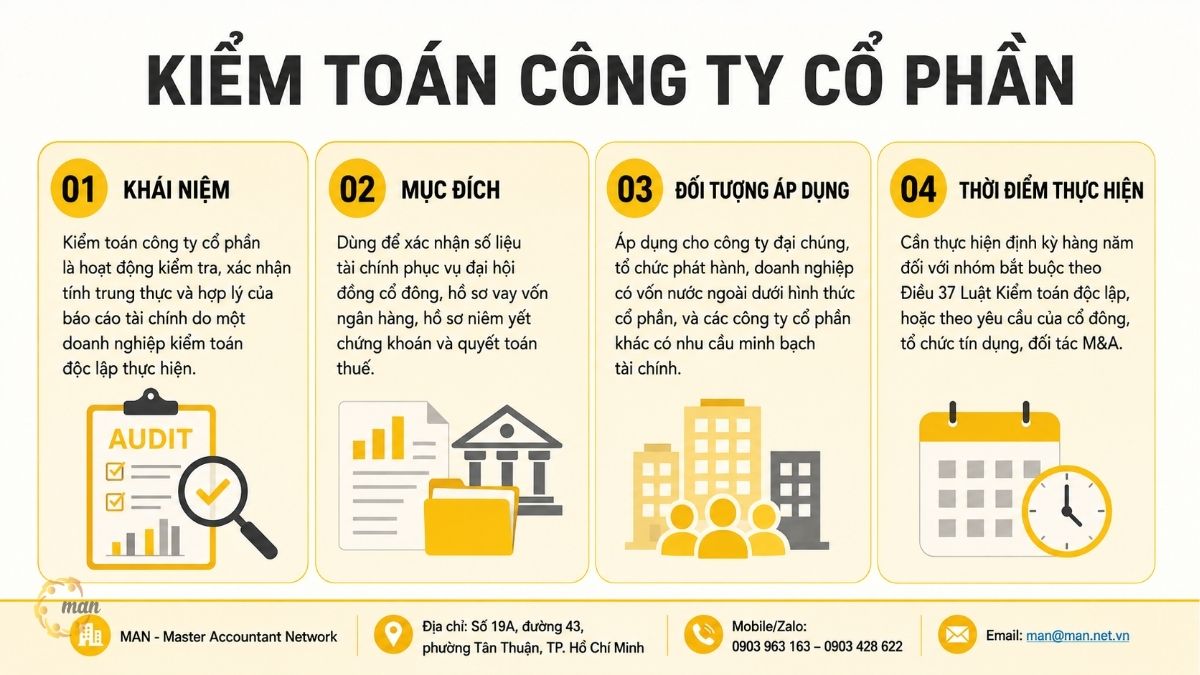
- Auditing a joint-stock company is the process of examining and verifying the accuracy and fairness of financial statements, carried out by an independent auditing firm.
- Used to verify financial data for shareholder meetings, bank loan applications, securities listing applications, and tax settlements.
- This applies to public companies, issuers, foreign-invested enterprises in the form of shares, and other joint-stock companies that require financial transparency.
- Annual audits are required for mandatory audits under Article 37 of the Independent Auditing Law, or at the request of shareholders, credit institutions, or M&A partners.
What is auditing a joint-stock company according to current legal regulations?

Auditing a joint-stock company is an activity carried out by an independent auditing firm with practicing auditors, who examines and provides an opinion on the fairness and accuracy of the financial statements. (According to Article 5) Law on Independent Auditing No. 67/2011/QH12, independent audit This involves professional auditors and auditing firms examining and providing independent opinions on financial statements. For joint-stock companies, the dispersed ownership across multiple shareholders makes the need for data transparency even more critical compared to single-owner businesses.
Unlike internal audits conducted by the company itself, audits of joint-stock companies always require an independent third party with no vested interest in the audited enterprise. The results are presented in an audit report, which is a legally binding document when the company works with banks, tax authorities, stock exchanges, or investment partners.
Three main legal documents govern the auditing obligations of joint-stock companies: Law on Independent Auditing No. 67/2011/QH12, with Article 37 specifying the groups of entities required to undergo auditing; the Securities Law 2019, with Article 120 regulating the publication of audited financial statements of public companies; and Decree 155/2020/ND-CP providing detailed guidance. In addition, Article 161 of the Enterprise Law 2020 stipulates the Audit Committee, an internal supervisory body operating in parallel with independent auditing in joint-stock companies that do not have a Supervisory Board.
Why should businesses care about auditing their joint-stock companies?
Unaudited financial statements are often questioned for their reliability, especially when the company has many shareholders who are not directly involved in management. Auditing a joint-stock company helps to separate responsibilities between the Board of Directors, the Executive Board, and shareholders, and also detects accounting errors early before the data is used for major decisions such as dividend distribution, capital increases, or share transfers.
According to Decree 41/2018/ND-CP, submitting financial statements without an attached audit report in cases where it is legally required can result in a fine of 10 to 20 million VND. If a company fails to prepare financial statements in accordance with regulations, the fine increases to 20 to 30 million VND. Beyond administrative penalties, the indirect consequences are even more serious: loan applications may be rejected by banks, listing applications may be returned by regulatory authorities, or shareholders may sue due to suspicions of financial data discrepancies.
See more articles at: Reputable auditing firms: Top 15 leading firms and solutions from MAN
Which joint-stock companies are required to have their financial statements audited?
Not all joint-stock companies are legally required to undergo a company audit. This obligation only applies to certain specific groups; the rest are audited on a voluntary basis. The table below summarizes the groups and their corresponding legal basis.
| Business group | Legal basis | Audit frequency |
| Public company, issuer, securities trading organization | Article 37 of the Independent Auditing Law 2011; Article 120 of the Securities Law 2019; Decree 155/2020/ND-CP | Annually, along with a review of the semi-annual report. |
| Foreign-invested enterprises (including joint-stock companies with foreign capital) | Article 37 of the Independent Auditing Law 2011 | Annual |
| State-owned enterprises that have been equitized, with state ownership exceeding 50% of charter capital. | Article 37 of the Independent Auditing Law 2011 and guiding documents of the Ministry of Finance | Annual |
| Unlisted joint-stock companies that do not belong to the above groups. | Not mandatory under current law, participation is voluntary. | Based on the need for borrowing, raising capital, restructuring, or shareholder requests. |
It's worth noting that unlisted joint-stock companies should still consider having their financial statements audited periodically if they plan to raise capital, issue private bonds, or prepare for an IPO in the near future, as institutional investors typically require a minimum of two to three years of audited financial statements.
What are the steps in a standard audit process for a joint-stock company?

A well-structured audit process for a joint-stock company is typically organized into five steps, ensuring compliance with Vietnamese auditing standards (VSA) and facilitating reconciliation during tax settlement.
- Step 1: Conduct a preliminary survey and sign the audit contract. Auditors research the industry, size, shareholder structure, and existing accounting system to assess the level of risk before signing a contract.
- Step 2: Develop an audit plan. Determine the materiality level, scope of inspection, personnel assignment, and timeframe appropriate to the specific characteristics of a joint-stock company.
- Step 3: Conduct an on-site audit. Gather audit evidence, reconcile accounts payable, conduct asset inventories, confirm bank balances, and review related-party transactions.
- Step 4: Compile, review, and issue the audit report. The results are independently reviewed by members of the auditing firm's board of directors before the official report is released.
- Step 5: Post-audit support. Providing advice on adjusting accounting records, preparing data for the annual general meeting of shareholders and settling corporate income tax.
See more articles at: Top 10 Reputable and Professional Auditing Service Companies in Ho Chi Minh City
What is the role of the audit committee in a joint-stock company?
According to Article 161 of the 2020 Enterprise Law, a joint-stock company organized without a Supervisory Board may establish an Audit Committee reporting to the Board of Directors, with members being non-executive personnel.
Decree 155/2020/ND-CP, in Articles 283 and 284, stipulates that the Audit Committee must meet at least twice a year, oversee the financial statement preparation process, and act as the focal point for coordination with independent audit firms. This mechanism does not replace external audits of joint-stock companies, but plays a supplementary internal control role, helping to detect irregularities early before the reports are published.
How does MAN – Master Accountant Network provide auditing services for joint-stock companies?
From the perspective of MAN – Master Accountant Network, the majority of difficulties in auditing joint-stock companies lie not in accounting techniques but in document preparation and coordination between departments. MAN's team of experts, with over 30 years of practical experience, typically begins by quickly reviewing the documentation system and identifying loopholes in the approval process before proceeding with the formal audit, thereby significantly shortening processing time compared to traditional methods.
What makes MAN's corporate audit service packages different?
The solutions from MAN – Master Accountant Network are categorized by the size and complexity of the business, helping joint-stock companies choose the appropriate package instead of paying for unnecessary items. Audit service price list The information below is for reference only; actual costs depend on the size, number of transactions, and accounting record of each business.
| Service package | Scope of work | Reference fee |
| Basic audit | Small-scale company, revenue under 20 billion VND, simple transaction structure. | 15 – 30 million VND/year |
| Standard audit | Medium-sized joint-stock company with many shareholders, and subsidiaries or branches. | 30 – 70 million VND/year |
| Auditing of public and listed companies. | Auditing the annual financial statements, combined with reviewing the semi-annual report, and preparing the information disclosure documents. | Individual pricing based on total asset size. |
What does MAN's team and security commitment entail?
The experts at MAN – Master Accountant Network are all certified public accountants (CPAs) who receive regular training in accordance with Vietnamese auditing standards and international practices. MAN is committed to absolute confidentiality of financial data, shareholder agreements, and other internal information throughout the auditing process of joint-stock companies, and assumes clear legal responsibility for the audit opinions issued.
In which regions does MAN provide auditing services for joint-stock companies?
MAN – Master Accountant Network provides nationwide auditing services for joint-stock companies, focusing its resources on key economic areas such as District 1 and District 7 in Ho Chi Minh City, as well as industrial zones in Binh Duong and Dong Nai, where many manufacturing joint-stock companies and foreign-invested companies are concentrated.
Case Study: How did a joint-stock company in District 7 handle its audit before raising capital?
Background
Company Y, a logistics company headquartered in District 7, Ho Chi Minh City, is preparing to negotiate with an investment fund to increase its charter capital. The investment fund requires the company's financial statements for the three most recent years to be audited by an independent firm, while the company has previously only prepared internal reports that have not been audited.
Handle
Following advice from MAN – Master Accountant Network, the company took three steps:
(1) Review and standardize accounting records for three consecutive years to eliminate discrepancies between records and original documents,
(2) conduct a retrospective audit of the joint-stock company for the two previous years and an audit of the current year,
(3) Prepare a set of documents explaining related party transactions to serve the investment fund's appraisal.
The measured results
- Completed the audit of three financial years within six weeks, meeting the deadline negotiated with the investment fund.
- The timely detection and correction of two incorrectly accounted liabilities prevented errors in the company's valuation.
- The investment fund approved the proposed valuation, and the capital increase transaction was completed on schedule.
Expert opinion: What risks do businesses commonly encounter when auditing a joint-stock company?
- Risk 1: Confusion between mandatory and voluntary audits: Many joint-stock companies believe that only listed companies need to be audited, leading to the omission of obligations when the company has foreign investment or belongs to the group of privatized state-owned enterprises. Incorrectly identifying the target group can result in the company being subject to back taxes and penalties when regulatory authorities review its information disclosure records.
- Risk 2: Incomplete documentation at the start of the audit: Lack of inventory records, confirmation of accounts payable, or transaction contracts with related parties are common reasons why the auditing process for joint-stock companies takes longer than expected. Experts at MAN – Master Accountant Network recommend that businesses prepare a minimum list of documents at the beginning of the fiscal year instead of waiting until close to the audit date.
- Risk 3: Transactions with shareholders and related parties that have not been properly approved: According to Article 293 of Decree 155/2020/ND-CP, certain transactions between public companies and shareholders and related parties must be approved by the general meeting of shareholders or the board of directors. If this approval step is omitted, auditors may issue a qualified opinion, directly affecting the company's reputation with investors.
- Risk 4: Failure to keep up-to-date with changes to the Audit Committee and the Supervisory Board: The transition in governance model between having and not having a Supervisory Board under the 2020 Enterprise Law requires joint-stock companies to update their charters and internal regulations accordingly. Errors at this stage often lead to the joint-stock company's audit report being required to provide additional explanatory notes before official release.
Conclude
Auditing a joint-stock company is not only a legal compliance procedure but also a tool to help businesses protect their reputation with shareholders, banks, and investors. Understanding the required parties, preparing complete documentation, and adhering to standard procedures will help joint-stock companies avoid unnecessary penalties and shorten processing time when they need to raise capital or list on the stock exchange.
MAN – Master Accountant Network is a tax, accounting, and auditing consulting firm with a team of experts boasting over 30 years of practical experience and a deep understanding of tax risk management in Vietnam. For personalized advice tailored to your business needs, contact MAN – Master Accountant Network today.
Other services
- Internal audit services
- Internal Control System Assessment Service
- Auditing services on request
- Professional tax audit services
- Construction auditing services
- Completed project settlement audit service
- Financial statement audit services
Service contact information at MAN – Master Accountant Network
- Address: No. 19A, Street 43, Tan Thuan Ward, Ho Chi Minh City
- Mobile/Zalo: 0903 963 163 – 0903 428 622
- E-mail: man@man.net.vn
- Google Business Profile: View MAN – Master Accountant Network's Google Business Profile
- LinkedIn Founder: View expert Le Hoang Tuyen's LinkedIn profile.
Responsible for production and professional content review by: Mr. Le Hoang Tuyen – Founder & CEO of MAN – Master Accountant Network, CPA Vietnam with over 30 years of experience in accounting, auditing, taxation, and corporate financial consulting.
Frequently Asked Questions about Auditing Joint Stock Companies
Are unlisted joint-stock companies required to undergo auditing?
No, unless the company has foreign investment or belongs to the group of privatized state-owned enterprises with state ownership exceeding 50% of charter capital. Other joint-stock companies conduct audits on a voluntary basis according to management needs or partner requirements.
How long does it usually take to audit a joint-stock company?
For small and medium-sized companies, the audit time for a joint-stock company ranges from two to four weeks. For publicly traded companies with multiple subsidiaries, the time can extend to six to eight weeks, depending on the complexity of the consolidation transaction.
What factors determine the cost of auditing a joint-stock company?
Costs depend on revenue, total assets, the number of branches or subsidiaries, the complexity of the transaction, and the state of the accounting records at the time the audit begins.
What impact will the failure to complete the audit on time have on the shareholders' general meeting?
Unaudited financial statements may prevent the annual general meeting of shareholders from having sufficient grounds to approve the profit distribution plan, and may also delay the disclosure of information for publicly listed companies.
Does a company that has recently converted from a limited liability company to a joint-stock company need to be audited immediately?
If, after the conversion, the company falls under the mandatory category according to Article 37 of the Law on Independent Auditing, for example, preparing for listing or having foreign capital, the enterprise needs to conduct an audit of the joint-stock company from the first fiscal year after the conversion to avoid disruption to legal documentation.