
Circular 98/2026/TT-BTC Issued by the Ministry of Finance on July 10, 2026, the model regulations on internal auditing applicable to state agencies and public service units are officially introduced, effective from September 1, 2026. This document replaces the previous one. Circular 67/2020/TT-BTCThis involves updating the organizational framework, position, duties, and powers of the internal audit department in the public sector, which has revealed some shortcomings after many years of applying the old regulations, especially as the state apparatus has undergone several rounds of restructuring and streamlining.
For ministries, ministerial-level agencies, government agencies, and thousands of public service units nationwide such as hospitals, schools, and research institutes, rebuilding the Internal Audit Regulations according to the new model is not only a legal compliance requirement but also an opportunity to review and tighten the internal control system. From the perspective of MAN – Master Accountant Network, this is also a period when many units are prone to making mistakes in organizational structure and document issuance if there is no clear transition roadmap starting now.
Summary of key points in Circular 98/2026/TT-BTC
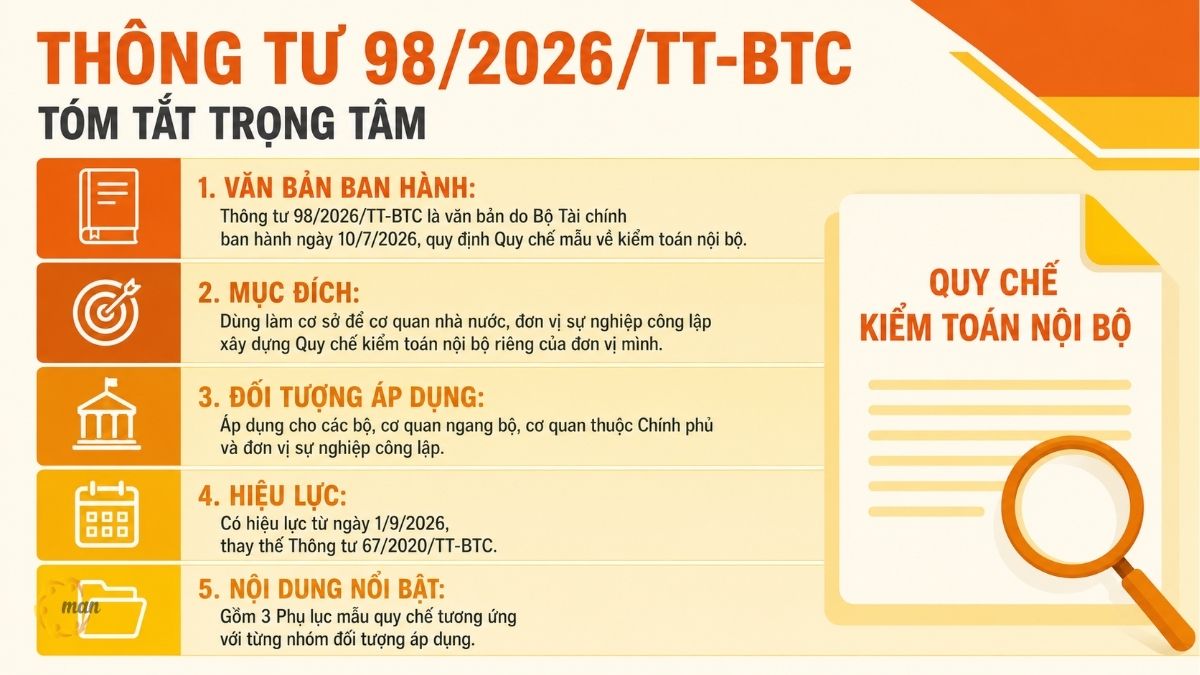
- Circular 98/2026/TT-BTC is a document issued by the Ministry of Finance on July 10, 2026, stipulating the model regulations on internal auditing.
- This serves as a basis for state agencies and public service units to develop their own internal audit regulations.
- This applies to ministries, ministerial-level agencies, government agencies, and public service units.
- Effective from September 1, 2026, replacing Circular 67/2020/TT-BTC.
- It includes 3 appendices of sample regulations corresponding to each group of applicable subjects.
What is Circular 98/2026/TT-BTC? Definition and scope of application.
Circular 98/2026/TT-BTC is a legal document signed and issued by the Minister of Finance on July 10, 2026. Its main content is a model regulation on internal auditing applicable to state agencies and public service units. In short, this is not a regulation to be applied directly, but rather a framework for each unit to use as a basis for drafting and issuing its own internal audit regulations, in accordance with its actual organizational structure.
According to the Circular, the scope of the model regulations includes the objectives, scope of activities, position, duties, powers, and responsibilities of the internal audit department and its relationship with other departments within the organization. The model regulations also clearly define the requirements for independence, objectivity, fundamental principles, and professional qualifications of internal auditors, as well as requirements for ensuring the quality of audit activities.
See more articles at: Reputable auditing firms: Top 15 leading firms and solutions from MAN
How is internal auditing defined according to Circular 98/2026/TT-BTC?
The model regulations define internal auditing as the examination, evaluation, and monitoring of the adequacy, appropriateness, and effectiveness of internal controls. This definition applies uniformly to all three model appendices, regardless of the type of entity. Internal audit departments, when operating, must comply with the Vietnamese Internal Auditing Standards and professional ethical principles issued or published by competent state agencies, and adhere to the internal audit procedures approved by the head of the entity.
What role does Circular 98/2026/TT-BTC play in risk management and internal control in the public sector?
Prior to Circular 98/2026/TT-BTC, many public service units applied the model regulations issued with Circular 67/2020/TT-BTC, which had already revealed some shortcomings in keeping pace with the organizational structure after the restructuring and streamlining of state agencies in the 2024-2026 period. Updating the model regulations helps to standardize the organization of internal audit departments across the entire system, avoiding a situation where each unit interprets and applies a different approach.
According to experts at MAN – Master Accountant Network, with over 30 years of experience in auditing and tax risk management consulting in Vietnam, a properly structured internal audit regulation is not only for dealing with inspections, but also helps unit leaders identify financial and compliance risks early on, before serious consequences arise. This is the core value that Circular 98/2026/TT-BTC aims for, rather than just being a formal administrative procedure.
The specific role of the Internal Audit Regulations under Circular 98/2026/TT-BTC is demonstrated through the following points:
- Establish an independent review and evaluation mechanism for the unit's internal control system.
- Assist the unit head in overseeing the governance and risk management process, ensuring high efficiency and effectiveness.
- Provide recommendations for improvement to help the unit achieve its operational goals, strategic objectives, plans, and work assignments.
- Establish a clear legal basis for the position and authority of internal auditors within the organization.
- This serves as a basis for higher-level state management agencies to compare and evaluate the level of compliance of each unit.
Which entities are required to comply with Circular 98/2026/TT-BTC?
Circular 98/2026/TT-BTC stipulates three model appendices for regulations corresponding to three different groups of applicable entities. Appendix I is for ministries, ministerial-level agencies, and government agencies. Appendix II is for public service units such as hospitals, schools, and research institutes. Appendix III applies to the remaining units within the scope of Decree 05/2019/ND-CP.
Each unit subject to these regulations must base its actions on the corresponding model regulations, in combination with the provisions of Decree 05/2019/ND-CPThe unit must take into account current legal regulations and its own organizational structure and operational practices to develop its own internal audit regulations. This means the unit cannot simply copy a template without considering its own specific operations, staff size, and management level.
Specifically for the Regulations in Appendix II for public non-profit organizations, the scope of application is defined into two groups. The first group includes internal audit activities of accounting units under that public non-profit organization. The second group includes the internal audit department itself, individual members of this department, and other organizations and individuals within the organization involved in internal audit activities. This method of defining the two groups of subjects helps the Regulations cover both the "audited" and the "auditing" parties.
Who is responsible for issuing the unit's internal audit regulations?
According to the model in Appendix II, the head of a public service unit is the person who decides to establish an internal audit department, in the form of a committee, a room, or a section within a room/room, usually located in the unit's office or a department with equivalent functions, depending on actual management requirements. For example, the internal audit of a hospital may be organized as an Internal Audit Department directly under the Board of Directors, or as a section within the General Planning Department, depending on the size and structure of each unit.
The head of the unit directly manages the internal audit department in terms of professional expertise, as evidenced by six main groups of authority and responsibilities:
- Issue and approve the unit's internal audit regulations.
- Approve the risk-based internal audit plan.
- Approve the internal audit budget and resource allocation plan.
- Receive information and reports from the internal audit manager regarding the department's performance, in line with the approved plan and any other arising issues.
- Approve decisions on the appointment and dismissal of the person in charge of internal audit.
- Assess whether limitations on internal audit resources or scope are negatively impacting the department's operational efficiency.
Conversely, the internal audit manager must report to the Head of Unit in two ways. Firstly, a direct professional report when necessary or when unexpected issues arise. Secondly, a periodic report on the purpose, authority, responsibilities, and performance of the department compared to the plan, clearly stating significant risks and controls, fraud risks, governance issues, and other matters as requested by the Head of Unit.
What are the objectives of internal auditing according to Circular 98/2026/TT-BTC?
According to the Regulations template in Appendix II, through inspection, evaluation, and consulting activities, internal auditors must provide assurances of independence and objectivity, along with recommendations revolving around the following three objectives:
- The unit's internal control system is properly established and operated, helping to prevent, detect, and promptly address emerging risks.
- The unit's risk management and governance processes ensure efficiency and high operational performance.
- The unit achieved its operational and strategic goals, as well as completing the planned tasks and assignments.
These three objectives form the basis for internal auditors to develop annual risk-based audit plans, rather than conducting broad, unfocused audits.
See more articles at: Top 10 Reputable and Professional Auditing Service Companies in Ho Chi Minh City
When does Circular 98/2026/TT-BTC take effect and which document does it replace?
Circular 98/2026/TT-BTC takes effect from September 1, 2026. From this date, Circular 67/2020/TT-BTC on the model internal audit regulations applicable to state agencies and public non-business units officially ceases to be in effect. Units currently applying the old model regulations need to review and update them before or immediately upon the new document's effective date to avoid legal gaps in internal audit practices.
Key dates to note for entities applying Circular 98/2026/TT-BTC:
- July 10, 2026: The Ministry of Finance signed and issued Circular 98/2026/TT-BTC.
- September 1, 2026: The circular officially comes into effect nationwide.
- From September 1st, 2026: Circular 67/2020/TT-BTC will cease to be in effect, and the old model regulations will no longer be valid as a basis for issuing new regulations.
- Prior to September 1, 2026: the unit should complete the review and draft of the new regulations for submission to the head of department for approval within the deadline.
Why should an organization develop its internal audit regulations early, rather than waiting until the effective date?
Practical experience at many public sector units shows that the process of rebuilding internal audit regulations usually takes 6 to 10 weeks, including time for reviewing the organizational structure, gathering feedback from relevant departments, and submitting it to the head of the organization for approval. If the process is delayed until close to September 1, 2026, the unit may rush, overlooking mandatory content as stipulated in Decree 05/2019/ND-CP, affecting the quality of the entire internal control system later on.
Legal documents related to Circular 98/2026/TT-BTC
When developing internal audit regulations, businesses and organizations should simultaneously review both Circular 98/2026/TT-BTC and Decree 05/2019/ND-CP, as the Circular only provides a model regulation for reference, while the minimum mandatory content framework remains in the original Decree. Ignoring either document could result in regulations lacking a proper basis or failing to meet the required content.
| Legal documents | Number / Date of Issue | Related content |
| Circular 98/2026/TT-BTC | Ministry of Finance, July 10, 2026 | Issuance of model regulations on internal auditing for state agencies and public service units, effective from September 1, 2026. |
| Circular 67/2020/TT-BTC | Ministry of Finance, 2020 | The previous model internal audit regulations will be replaced effective September 1, 2026. |
| Decree 05/2019/ND-CP | Government, 2019 | Regulations on internal auditing serve as the basis for determining the minimum content of the internal audit regulations for each unit (Clause 1, Article 12). |
| Vietnamese Internal Auditing Standards | The competent state agency announces | Professional standards that must be followed when the internal audit department is operating. |
Case Study: How do public non-profit organizations develop internal audit regulations according to Circular 98/2026/TT-BTC?
Background
A provincial-level general hospital with over 800 beds and approximately 1,500 staff members has been implementing an internal audit regulation based on the template in Circular 67/2020/TT-BTC since 2021. The hospital's internal audit department, under the General Planning Department, has only two part-time staff members and lacks a clear risk reporting process to the Board of Directors, leading to many financial issues only being discovered after consequences have already occurred.
How to handle it
Following advice from MAN – Master Accountant Network, the hospital is taking three steps to transition to the regulations under Circular 98/2026/TT-BTC:
- Review the organizational structure of the internal audit department, considering separating it into an independent Internal Audit Department directly under the Board of Directors instead of having it concurrently under the General Planning Department as before.
- Compare each clause in Appendix II with actual operations to revise the Regulations, especially the definitions of terms and scope of activities, to suit the hospital's scale.
- Develop a risk-based internal audit plan and submit it to the hospital director for approval before the Circular takes effect to ensure there is no disruption.
The measured results
- The internal audit department has been upgraded to an independent department, reporting directly to the Board of Directors instead of indirectly through the General Planning Department as before.
- The new regulations clearly define the responsibility for periodic reporting, enabling the Board of Directors to identify financial risks an average of one to two months earlier than under the old system.
- The 2026 financial audit at the hospital did not generate any recommendations related to the internal audit department's organizational structure, significantly saving time spent explaining matters to the audit team.
A 5-step roadmap for implementing Circular 98/2026/TT-BTC for public non-business units.
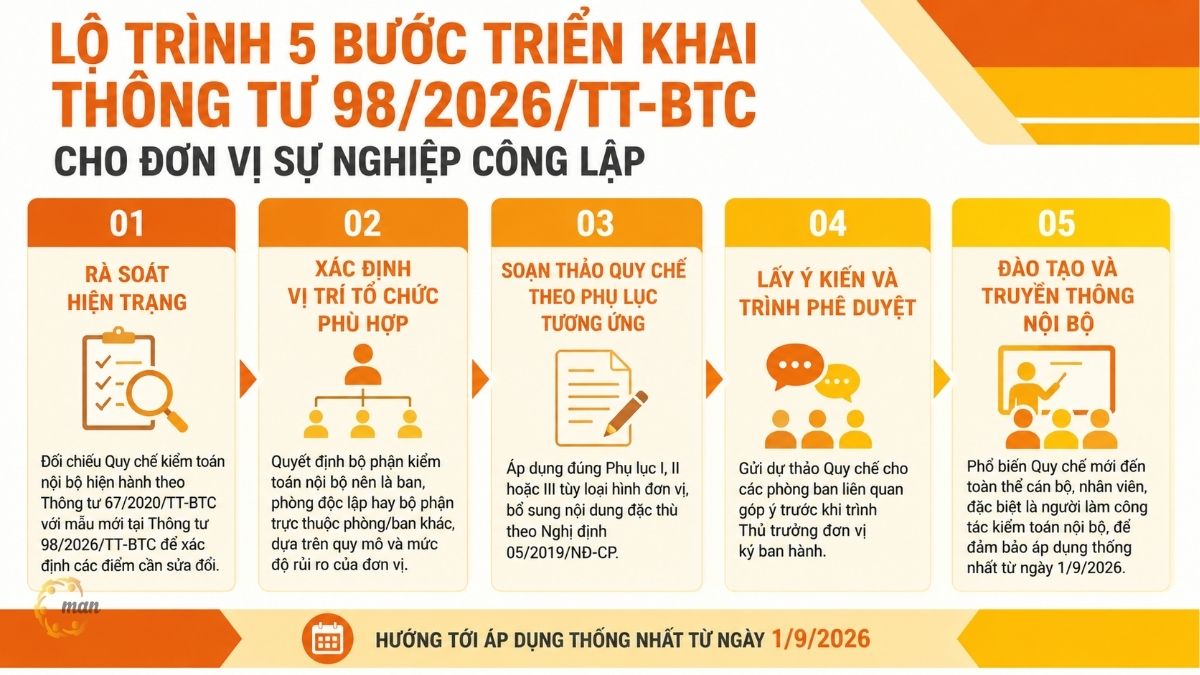
Based on practical consulting experience, MAN – Master Accountant Network suggests the following five-step roadmap for a smooth and timely organizational transformation:
- Review of the current situation: Compare the current Internal Audit Regulations under Circular 67/2020/TT-BTC with the new template in Circular 98/2026/TT-BTC to identify points that need amendment.
- Identify the appropriate location for the organization: The decision on whether the internal audit department should be an independent unit or a department within another department/division should be based on the size and level of risk of the organization.
- Draft the Regulations according to the corresponding Appendix: Apply Appendix I, II, or III depending on the type of unit, supplementing specific content as per Decree 05/2019/ND-CP.
- Gather feedback and submit for approval: The draft regulations will be sent to relevant departments for comments before being submitted to the Head of the unit for signing and promulgation.
- Internal training and communication: Disseminate the new regulations to all officers and employees, especially those working in internal auditing, to ensure consistent application from September 1, 2026.
Comparison table of Circular 98/2026/TT-BTC and Circular 67/2020/TT-BTC
In essence, Circular 98/2026/TT-BTC does not change the governance philosophy. internal audit The public sector, primarily focusing on updating the presentation and classification of regulations to better reflect the current state apparatus after the recent restructuring and streamlining, is a key point for businesses and organizations to note, avoiding the misconception that this constitutes a comprehensive reform of the fundamental nature of internal auditing.
| Criteria | Circular 67/2020/TT-BTC | Circular 98/2026/TT-BTC |
| Validity | Since 2020 | From September 1, 2026 |
| Appendix number | General application, with little differentiation based on unit type. | Three separate sample appendices for each target group. |
| Reference base | Decree 05/2019/ND-CP | Decree 05/2019/ND-CP retains the legal basis but updates the format of the form. |
| Current validity status | Expires September 1, 2026 | Currently in effect |
Expert opinion: Common risks when implementing Circular 98/2026/TT-BTC
Experts at MAN – Master Accountant Network, with over 30 years of auditing and tax consulting experience in Vietnam, point out several common risks that state agencies and public service units may encounter when transitioning to the model regulations according to Circular 98/2026/TT-BTC.
Risk 1: Copying the prototype, ignoring unit specifics.
Many units copied the sample content in the Appendix almost verbatim without adjusting the organizational structure and the relationship between the internal audit department and other departments to reflect reality. As a result, the regulations issued did not accurately reflect the operational structure, causing difficulties in conducting actual audits and when comparing them with higher-level inspection and audit teams.
Risk 2: Delay in issuing the new regulations before the effective date.
From September 1st, 2026, Circular 67/2020/TT-BTC will expire. If the unit has not yet issued a new Internal Audit Regulation, the internal audit department may operate without a clear legal basis during the transition period, affecting the legal validity of audit reports issued during that time.
Risk 3: Failure to address conflicts of interest in accordance with regulations regarding related parties.
The model regulations specify in considerable detail the group of people involved in internal audit work. In practice, some units still assign audit personnel to areas related to their own relatives, leading to risks regarding objectivity during subsequent inspections and audits, and potentially even violating the principle of internal audit independence.
Risk 4: Lack of budget and resources for the internal audit department.
The model regulations empower unit heads to approve budgets and resource plans for internal auditing, but many units still view it as a secondary department, failing to allocate sufficient dedicated personnel. The solution from MAN – Master Accountant Network for this risk group is to develop an internal training roadmap combined with hiring independent consultants during the initial transition phase, helping units optimize tax and operating costs while ensuring audit quality meets standards.
Conclude
Circular 98/2026/TT-BTC is a necessary update to the legal framework for internal auditing in the public sector, helping state agencies and public service units have a more practical model for organizing and operating internal audit departments in a transparent and effective manner. The timely and accurate transition will help units avoid legal gaps during the transition period and improve the quality of internal risk management in the long term, rather than viewing it merely as an administrative procedure.
MAN – Master Accountant Network is a tax, accounting, and auditing consulting firm with a team of experts boasting over 30 years of practical experience and a deep understanding of tax risk management and auditing in Vietnam. We provide auditing services Internal services include consulting on the development of internal audit regulations according to Circular 98/2026/TT-BTC, along with accounting and tax settlement services for businesses and public service units. Over 500 clients have returned for a second service in the past year. Contact MAN for a free consultation for your organization.
Other services
- Internal audit services
- Internal Control System Assessment Service
- Auditing services on request
- Professional tax audit services
- Construction auditing services
- Completed project settlement audit service
- Financial statement audit services
Service contact information at MAN – Master Accountant Network
- Address: No. 19A, Street 43, Tan Thuan Ward, Ho Chi Minh City
- Mobile/Zalo: 0903 963 163 – 0903 428 622
- E-mail: man@man.net.vn
- Google Business Profile: View MAN – Master Accountant Network's Google Business Profile
- LinkedIn Founder: View expert Le Hoang Tuyen's LinkedIn profile.
Responsible for production and professional content review by: Mr. Le Hoang Tuyen – Founder & CEO of MAN – Master Accountant Network, CPA Vietnam with over 30 years of experience in accounting, auditing, taxation, and corporate financial consulting.
Frequently Asked Questions about Circular 98/2026/TT-BTC
Which agency issued Circular 98/2026/TT-BTC?
Signed and issued by the Minister of Finance on July 10, 2026, this regulation stipulates the model regulations on internal auditing for state agencies and public service units.
When does Circular 98/2026/TT-BTC take effect?
Effective from September 1, 2026, this Circular will simultaneously replace Circular 67/2020/TT-BTC on the same matter.
Which entities are required to apply Circular 98/2026/TT-BTC?
Ministries, ministerial-level agencies, government agencies, and public service units shall comply with the three sample regulations attached to the Circular.
Can the unit retain the old regulations as stipulated in Circular 67/2020/TT-BTC?
No. Circular 67/2020/TT-BTC expires on September 1, 2026, so the unit needs to reissue the Internal Audit Regulations using the new template.
What are the minimum requirements for the internal audit regulations of an organization?
Based on Clause 1, Article 12 of Decree 05/2019/ND-CP, combined with the model regulations in Circular 98/2026/TT-BTC and the actual organizational structure of each unit.